Sales and marketing
Win More Jobs From Quote Requests: Reply Like This
Answer Kenyan quote requests fast and clearly: what to include, how to show VAT, the 10% estimate rule, government RFQs and the follow-up that wins work.
Biashara Pros editorial team 13 min read
Facts checked against official sources on 15 November 2026. How we check facts

To win a job from a quote request, reply fast and make your quote easy to say yes to. Confirm you got the request the same day, ask only the questions you need, then send one clear written quote: what you will supply, the price with VAT shown plainly, the delivery date, payment terms, how long the price holds, and what is not included.
A message lands on your phone: “Hi, please send a quote for 40 polo shirts with our logo.”
You’re busy, so you reply tomorrow. By then the buyer has three other prices.
Sound familiar? Often the job isn’t lost on price. It’s lost on a slow reply, or a quote the buyer can’t understand.
Let’s fix both.
Why does a fast reply matter so much?
Because the buyer is almost always asking more than one business at the same time.
Government offices and public schools buying through a request for quotations are required to ask at least three suppliers, unless that is not possible[1]. Private buyers often do the same, because comparing quotes is how they show their boss they got a fair price.
That means your quote sits in a pile. The first clear reply sets the standard the others are judged against.
Speed also tells the buyer something. A business that answers a quote request quickly is likely to answer a delivery problem quickly too.
You don’t need the full quote in an hour. You need a short reply that says, “Got it, here’s when you’ll have our price.”
What should a winning quote include?
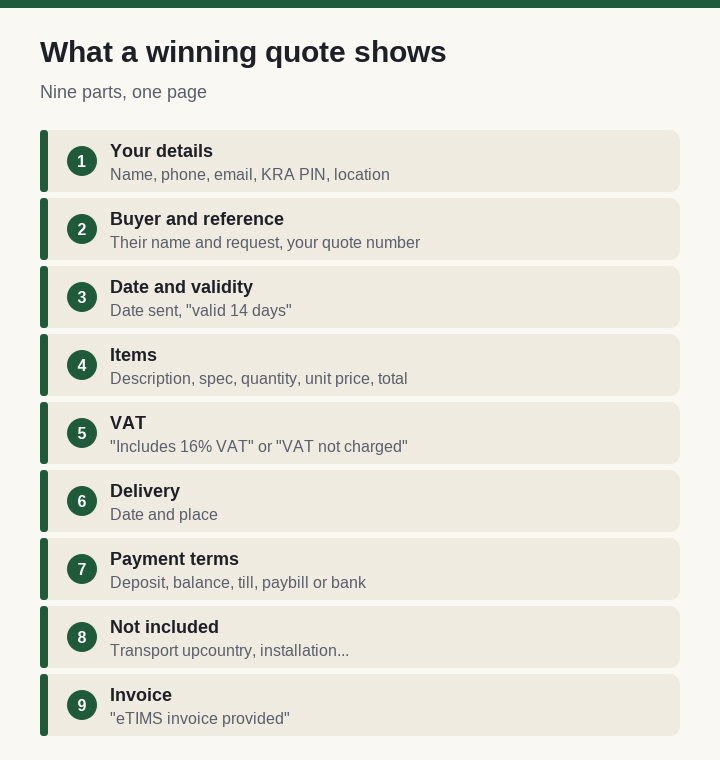
A winning quote answers every question the buyer would otherwise have to ask you. If they have to call you to understand it, the next quote in the pile may win.
Put these on every quote:
| Part of the quote | What to write |
|---|---|
| Your details | Business name, phone, email, KRA PIN, physical location |
| Buyer and reference | Buyer’s name, their request date or reference, your quote number |
| Date and validity | Date sent and how long the price holds, for example “valid 14 days” |
| Items | Each item on its own line: description, size or spec, quantity, unit price, line total |
| VAT | ”Prices include 16% VAT” or “VAT not charged: not VAT registered” |
| Delivery | Date or number of working days from order, and where you deliver |
| Payment terms | Deposit, balance, when, and how (M-Pesa till or paybill, bank) |
| Not included | Anything the buyer might assume is in, such as transport upcountry or installation |
| Invoice | ”eTIMS invoice provided” |
The last line matters more than many owners think.
KRA says that since 1 January 2024, a business can only claim an expense if it is supported by an electronic tax invoice[7]. So a business buying from you needs that invoice. KRA also says all persons in business, VAT registered or not, must issue electronic tax invoices[7]. Saying “eTIMS invoice provided” on the quote answers their question before they ask it.
How should you show VAT on a quote?
State it in words, every time. “KSh 50,000” on its own leaves the buyer guessing whether VAT is inside or on top.
If you are VAT registered, the general rate is 16%[6]. Write “all prices include 16% VAT”, or show the price before VAT, the VAT, and the total on separate lines.
If you are not VAT registered, say so: “VAT not charged, supplier not VAT registered”. KRA says any person supplying, or expecting to supply, taxable goods and services worth KSh 5 million or more a year must register for VAT[6]. Below that, registration is voluntary and subject to conditions[6].
Never add VAT to a quote if you are not registered for it. KRA says VAT is collected by VAT-registered persons acting as agents of the Government[6], so you would be charging the buyer a tax you have no right to collect.
Why might a big buyer pay you less than your total?
Some buyers are appointed by KRA as withholding VAT agents. When you quote a new organisation, ask whether it withholds VAT. KRA says withholding VAT is charged at 2% of the value of taxable supplies[6].
This only affects you if you are VAT registered. The agent keeps back part of the VAT and pays it to KRA for you. You still file your VAT return and account for the balance[6], and you use the amount withheld as a credit.
Here’s a worked example for a VAT-registered supplier:
- Price before VAT: KSh 100,000
- VAT at 16%: KSh 16,000, so the quote total is KSh 116,000
- Withholding VAT at 2% of KSh 100,000: KSh 2,000 kept back by the buyer
- Cash you receive: KSh 114,000, with KSh 2,000 to claim as a credit
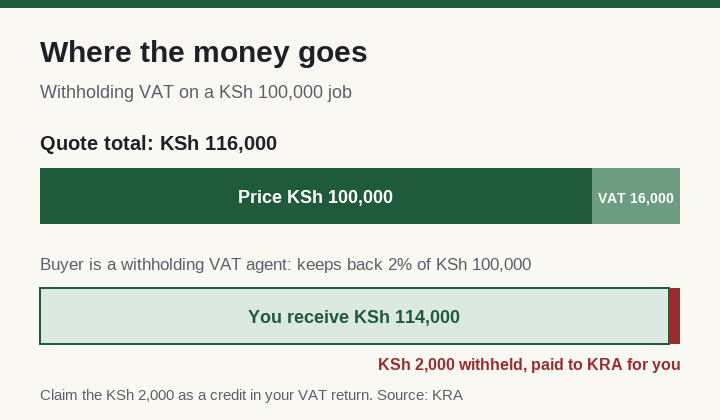
Plan your cash flow around the KSh 114,000, not the KSh 116,000. Our VAT calculator helps with the sums.
Is your quote a promise, or just an estimate?
It depends on how you write it, and the law treats the two differently. A fixed quote is a price you will charge. An estimate is your best guess of the total.
If you give a consumer an estimate, the Consumer Protection Act says you may not charge more than 10% above it[3]. If you do, the customer can insist on paying the estimated price[3].
So an estimate of KSh 50,000 lets you charge up to KSh 55,000. Not KSh 60,000.
These rules come from the Consumer Protection Act and cover consumer agreements. Whether a particular company or institution counts as a consumer depends on the deal, and a government RFQ follows its own terms. The safe habit is to stay within 10% for every buyer.
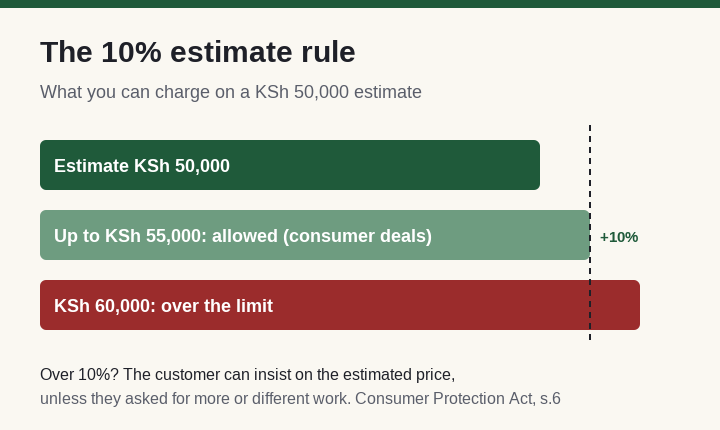
The rule has a fair exception. You and the customer can agree to change the estimate or price if the customer asks for more or different goods or services[3]. Get that change in writing, even a WhatsApp message saying “Yes, add the extra 10 shirts at KSh 850 each”.
Two more rules push you towards clear wording:
- Unclear terms count against you. The Consumer Protection Act says any ambiguity in a consumer agreement that allows more than one reasonable reading is interpreted to the benefit of the consumer[4].
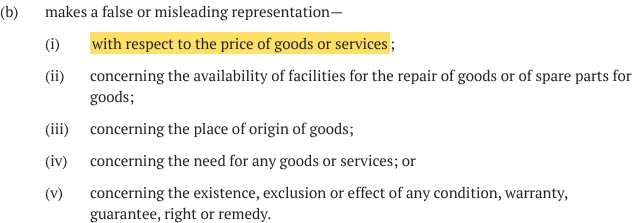
- No misleading prices. The Competition Act makes it an offence to make a false or misleading representation with respect to the price of goods or services[5]. A low headline price with surprise extras at delivery is exactly the kind of thing to avoid.
If your costs truly can’t be fixed yet (repairs, building work, fabric prices that move weekly), call it an estimate, say what could change it, and keep within the 10%.
How do you answer a request for quotations from a school, county or government office?
Follow their document to the letter. In public procurement, the cheapest price only wins if it meets every requirement.
The Public Procurement and Asset Disposal Act sets how a request for quotations (RFQ) works[1]:
- The RFQ sets out the buyer’s specific requirements, and where and when quotations must be submitted[1].
- It goes to suppliers on the entity’s register, and to at least three of them, unless that is not possible[1].
- The successful quotation is the one with the lowest price that meets the requirements set out in the RFQ[1].
- If even the lowest price is above prevailing market rates, the RFQ is cancelled[1].
- The winner gets a purchase order and must confirm it in writing[1].
So read the requirements twice. A missing document, a wrong specification or a late submission can knock you out, however good your price.
If your business is owned by women, youth or persons with disabilities, look into the reserved share. The Act says a procuring entity must reserve a prescribed percentage of its procurement budget, not less than 30%, for the disadvantaged group[2]. The tenders board lists current public opportunities.
How do you answer a quote request, step by step?
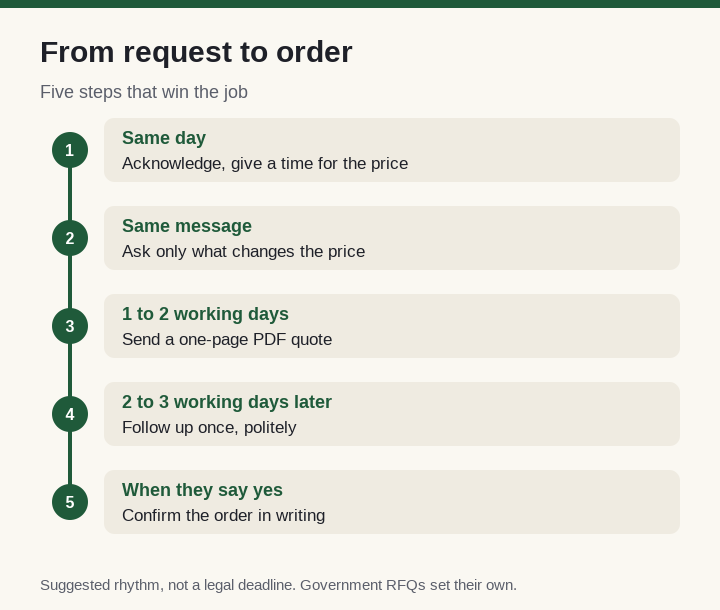
- Reply the same day. Thank the buyer, confirm what they asked for, and say when they will get your price. “Thanks, we’ll send the quote by 3pm tomorrow.”
- Ask only the questions that change the price. Quantity, size or spec, delivery place and date, and any brand or standard they need. Put them in one message, not five.
- Price it properly. Add your buying cost, transport, labour, packaging and payment charges, then your margin. Our guide to pricing for Kenyan businesses walks through it.
- Write it on one page if you can. Use the parts in the table above. Number your quotes so you can find them later.
- Send it as a PDF. Name the file clearly, such as “Quote 0412, 40 branded polo shirts.pdf”. A PDF looks the same on every phone and can be forwarded to whoever approves the spending. Our free invoice generator can be adapted for a simple layout.
- Add one line on why you. A sentence on similar work you’ve done, with one or two photos. Not a brochure.
- Follow up once. If you hear nothing in two or three working days, send a short, polite message asking if they need anything else to decide.
- Confirm the order in writing. When they say yes, reply with the agreed items, price, delivery date and payment terms, and ask them to confirm. Keep that message.
What do you need ready before quote requests come in?
Having these ready is what lets you reply in hours, not days:
- A quote template with your logo, KRA PIN, contacts and payment details already filled in
- A current price list with your costs worked out, updated whenever supplier prices change
- Your VAT status clear, and the exact VAT wording you will use[6]
- eTIMS set up and tested, so you can issue the invoice the moment you are paid[7]
- Photos of past work, sorted by type, ready to attach
- Supplier lead times for the items you don’t keep in stock
- Your standard terms: deposit, delivery, returns and how long a quote stays valid
What tips help small businesses win more quotes?
- Quote what they asked for first. Then, if you have a better or cheaper option, add it as a clearly marked alternative. Don’t swap their request for yours.
- Use the buyer’s words. If they wrote “navy blue polo, embroidered logo”, your line item says exactly that.
- Be honest about delivery. A realistic date beats an exciting one you’ll miss, especially in December when transport and suppliers slow down.
- Keep a written trail. WhatsApp is fine. Voice notes are not, because no one can forward a voice note to an accounts office.
- Make it easy to pay. Put your till, paybill or bank details on the quote, with the name the buyer will see when they pay.
- Look at who you lose to. When a buyer says no, ask politely what decided it. Price, speed or spec? It tells you what to change.
If buyers find you through a Biashara Pros business page, keep your prices there current too, so your quote matches what they already saw.
What should you never do when quoting?
- Don’t send a price with no breakdown. “Total KSh 85,000” invites suspicion and bargaining.
- Don’t leave out costs you know will come up. Transport, installation or branding setup belong on the quote. A surprise extra at delivery can be a misleading price[5].
- Don’t charge for a quote without warning. If you repair vehicles or other goods covered by the Consumer Protection Act, you can’t charge a fee for an estimate unless you tell the customer in advance that there is a fee and how much. You can’t charge it at all if they go ahead and you do the work[8].
- Don’t add VAT you’re not registered for. Only registered businesses collect VAT[6].
- Don’t promise what your supplier hasn’t confirmed. Check stock and lead times before you commit to a date.
- Don’t send ten follow-up messages. One polite follow-up, then leave the door open.
Which quoting mistakes lose jobs?
Replying late. By the time you answer, the buyer has compared others. Instead, acknowledge the same day, even if the full quote comes tomorrow.
Quoting something different. You offer a cheaper fabric without saying so, and the buyer thinks you’re cheating them. Instead, quote their spec first and put your alternative on a separate line.
No validity date. Three months later the buyer comes back expecting the old price, after your supplier has put prices up. Instead, write “valid 14 days” or “valid 30 days”.
Unclear VAT. The buyer budgets KSh 50,000 and your invoice says KSh 58,000. Instead, say “including 16% VAT” or “VAT not charged”.
Missing one requirement on a government RFQ. Only quotations that meet the requirements can win, however low the price[1]. Instead, tick off every item in the RFQ before you submit.
Pricing below cost to win. You win the job and lose money on it. Instead, compete on speed, clarity and proof of past work.
How much does quoting cost, and how long should it take?
Quoting mostly costs your time. A template, a price list and a free PDF tool cost little or nothing to set up, and they cut each quote from an hour to a few minutes.
Here’s a realistic rhythm to aim for. These are our suggestions, not legal deadlines:
| Stage | Aim for |
|---|---|
| Acknowledge the request | Same day |
| Ask your questions | In the same message, or within a few hours |
| Send the quote | Within one to two working days for standard items |
| Follow up | Once, after two or three working days |
| Quote validity | 14 to 30 days, written on the quote |
| Confirm the order | The same day the buyer says yes |
Government RFQs are different: the procuring entity sets where and when quotations must be submitted[1]. Their deadline is the one that counts, and late is out.
Remember the cash side too. If a withholding VAT agent pays you, budget for 2% of the taxable value arriving as a VAT credit, not cash[6].
Your quote checklist
Screenshot this and check it before every quote goes out:
- Replied to the buyer the same day.
- Price-changing questions asked in one message.
- Business name, KRA PIN and contacts on the quote.
- Quote number, date and validity period.
- Every item on its own line with quantity and unit price.
- VAT stated in words.
- Delivery date and place.
- Payment terms and how to pay.
- What’s not included.
- “eTIMS invoice provided”.
- Sent as a clearly named PDF.
- One follow-up diarised.
- Order confirmed in writing when they say yes.
This guide is general information, not legal advice. For a disputed bill or contract, speak to an advocate.
Want to keep the customers you win? Read how to get and keep customers in Kenya.
Common questions
How long should a quotation be valid for in Kenya?
For a private quote, you set the validity period yourself and write it on the quote, for example 14 or 30 days. Pick a period you can hold given how fast your supplier prices change. For government requests for quotations, follow the period the procuring entity sets in its request.
Can I charge for preparing a quote?
You can, if you tell the buyer before you start and they agree. If you repair vehicles or other goods covered by the Consumer Protection Act, you may not charge an estimate fee unless the customer is told in advance that there is a fee and how much. You may not charge it at all if the customer goes ahead and you do the repair.
Is a quote sent on WhatsApp valid?
WhatsApp is a common way to send quotes in Kenya, and the chat keeps a dated written record of what you offered and when. Send it as a PDF with your business name, the date and a reference number, so the buyer can forward it to whoever approves the spending.
What is the difference between a quotation and a proforma invoice?
A quotation offers a price for the buyer to accept or decline. A proforma invoice is usually sent after the buyer agrees, to show exactly what they will pay before goods move, often so they can arrange payment. Neither replaces the eTIMS tax invoice you issue when you make the sale.
Should I quote lower than I can afford to win a first job?
No. A price below your cost loses money on every unit, and the buyer will expect the same price next time. Win on clarity, speed and proof of past work instead, and keep your price at a level that pays your costs and leaves a margin.
What if the buyer asks me to change my price after I quote?
Treat it as a new offer. Change the quote in writing with a new date and reference, and say what changed, such as a smaller quantity or a different material. Don't cut the price without changing anything, or the buyer will expect to bargain every time.
Sources
- Public Procurement and Asset Disposal Act (Cap. 412C), section 106 (procedure for request for quotations), Kenya Law
"the request shall be given to as many persons as necessary to ensure effective competition and shall be given to at least three persons, unless that is not possible"

- Public Procurement and Asset Disposal Act (Cap. 412C), section 157(5) (reservations), Kenya Law
"reserve a prescribed percentage of its procurement budget, which shall not be less than thirty per cent, to the disadvantaged group"

- Consumer Protection Act (Cap. 501), section 6 (estimates), Kenya Law
"If a consumer agreement includes an estimate, the supplier shall not charge the consumer an amount that exceeds the estimate by more than ten per cent."

- Consumer Protection Act (Cap. 501), section 7 (ambiguities), Kenya Law
"Any ambiguity that allows for more than one reasonable interpretation of a consumer agreement provided by the supplier to the consumer ... shall be interpreted to the benefit of the consumer."

- Competition Act (Cap. 504), section 55 (false or misleading representations), Kenya Law
"makes a false or misleading representation— (i) with respect to the price of goods or services"
- KRA: Value Added Tax (registration, rates and withholding VAT)
"Withholding VAT is charged at a the rate of 2% of the value of taxable supplies with effect from 07/11/2019."

- KRA: What is eTIMS
"The law requires that for any person to claim their business expense, the expense must be supported by an electronic tax invoice as at 1st January 2024."
- Consumer Protection Act (Cap. 501), section 45(1) and (3) (estimate fee), Kenya Law
"no repairer shall charge a fee for an estimate unless the consumer is told in advance that a fee will be charged and the amount of the fee. ... A repairer shall not charge a fee for an estimate if the work or repairs in question are authorized and carried out."

This is general information, not advice for your situation. Rules and rates change with each Finance Act. Before a decision with real money at stake, confirm with a licensed accountant or advocate. Spotted something out of date? Tell us at support@biasharapros.com and we will fix it.