Registration
Business Name or Ltd? Choose the One That Protects Your Assets
Business name or limited company? Compare the BRS fees (KSh 950 vs KSh 10,650), personal liability, tax, yearly filings and when to switch, with steps for each.
Biashara Pros editorial team Updated 8 November 2026 13 min read
Facts checked against official sources on 8 November 2026. How we check facts

Register a business name if you are starting small, alone or with a partner, and can carry the business’s debts yourself. Register a private limited company if you will sign big contracts, borrow, take on investors or want your home and savings kept apart from the business. A business name costs KSh 950 at BRS. A private limited company costs KSh 10,650[1].
That’s the short answer. The longer one depends on what you are building, who you sell to and how much risk you carry.
So let’s walk through it the way you would with a friend who has done both.
What is the real difference between a business name and a limited company?
The difference is who the law sees. A business name is just you, trading under a name. A limited company is a separate legal person.
The Business Registration Service (BRS) puts it plainly. A business name “is not a legal entity” and the owner “is personally responsible for its debts”[2].
A company is different. Under the Companies Act, 2015, once a company is incorporated its members become a body corporate under the name on the certificate[4].
In a company limited by shares, each member’s liability is limited to any amount unpaid on the shares they hold[4].
What does that mean on a normal Tuesday in Nairobi?
- Business name: if the business owes a supplier KSh 400,000 and can’t pay, the supplier can come after you personally.
- Limited company: the debt belongs to the company. Your personal risk is usually what you put into your shares, unless you signed something personally.
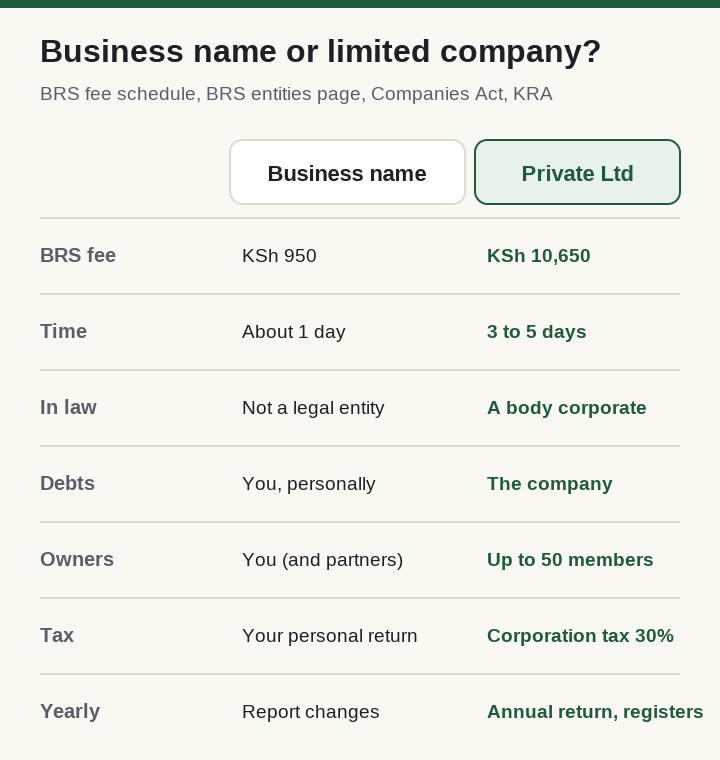
Business name is the simple label BRS uses for a sole trader or partners trading under a name. Private limited company is a company whose name ends in “Limited” or “Ltd”[4], and which can’t invite the public to buy its shares[2].
How much does each one cost to register?
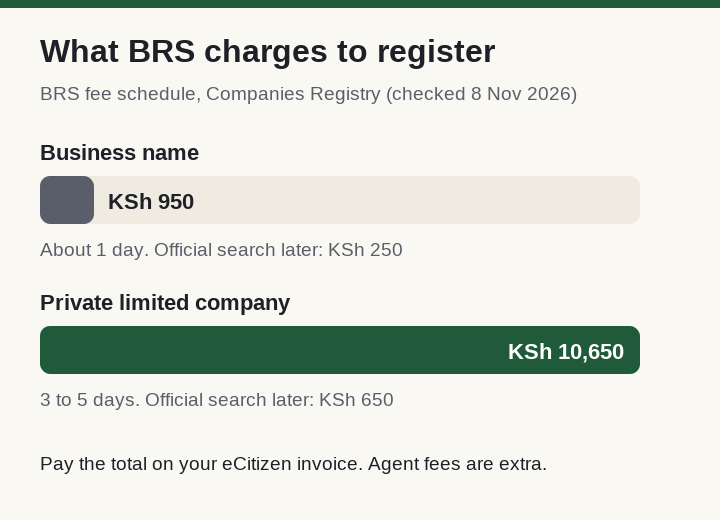
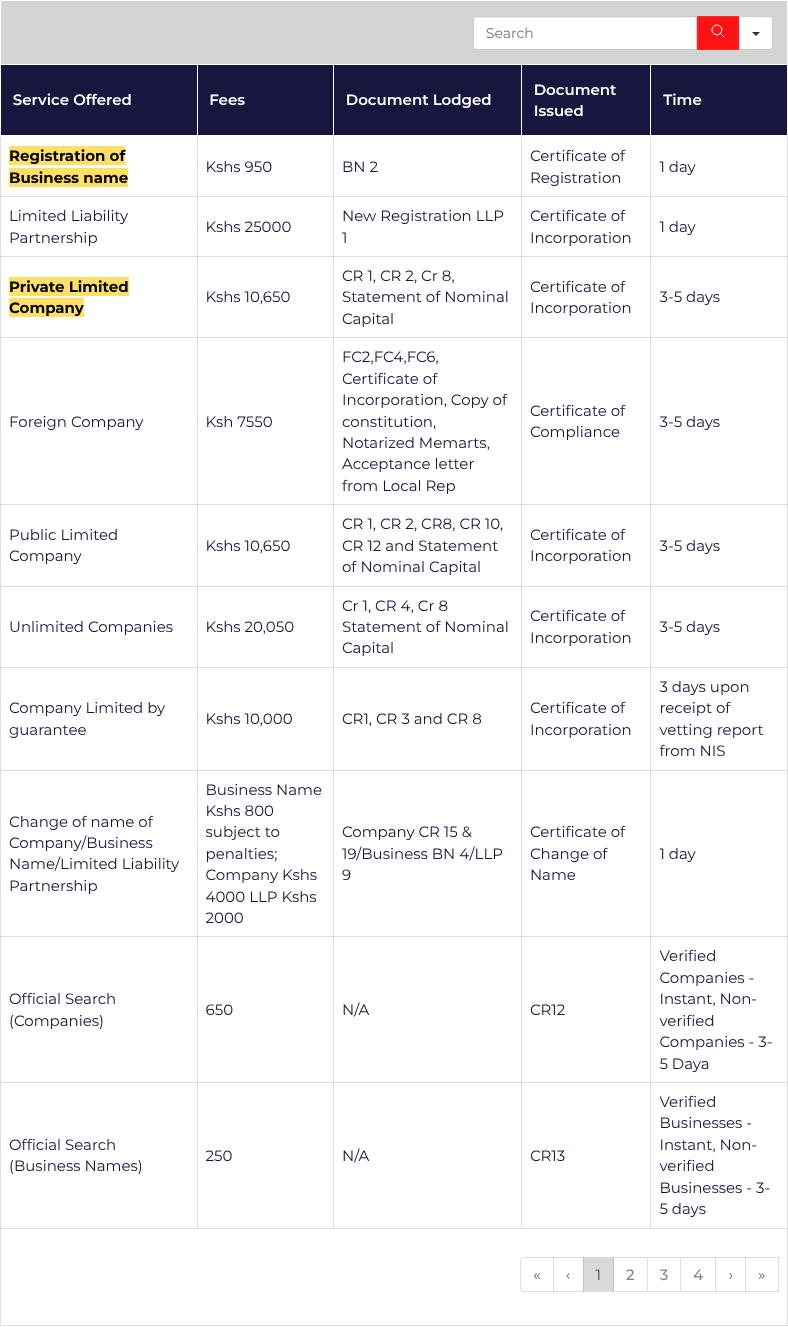
The government fee is KSh 950 for a business name and KSh 10,650 for a private limited company, paid on eCitizen[1].
Here’s what the BRS fee schedule says, side by side[1]:
| Business name | Private limited company | |
|---|---|---|
| Registration fee | KSh 950 | KSh 10,650 |
| Official search later | KSh 250 | KSh 650 |
| Time to register | About 1 day | 3 to 5 days |
| Change of name | KSh 800 (subject to penalties) | KSh 4,000 |
| Closing down | Cessation: KSh 800 (subject to penalties) | Dissolution: KSh 4,000, about 90 days |
The fee is only part of it. Budget for these too:
- Your time or an agent’s fee. A company asks for more details (directors, shareholders, shares), so many people pay someone to file. Agents set their own fees, so get two quotes.
- The exact eCitizen total. BRS’s own FAQ quotes KSh 10,750 for a company, against KSh 10,650 on the fee schedule[3][1], so pay what your invoice shows.
- Yearly running costs. A company has more filings each year (more on that below), and many owners pay an accountant for them.
Want to see the fees for other structures, like an LLP? Try our business registration cost tool.
Who should pick a business name?
A business name suits you when you are testing an idea, selling alone or with one partner, and your risk is small.
Think of a salonist moving from home to a small shop in Kitengela. Or a freelance graphic designer billing a few clients a month.
A business name fits when:
- Your debts stay small and you could pay them yourself if things went wrong.
- You don’t need outside investors. Nobody can buy “shares” in a business name.
- Your buyers are mostly individuals, who rarely ask for company documents.
- You want simple paperwork while you learn what sells.
One thing that surprises people: you may not even need to register if you trade under your own name.
The Registration of Business Names Act says an individual must register when trading under a name that does not consist of their surname with only their forenames or initials added[5].
So “Achieng Otieno” trading as herself doesn’t strictly need it. “Achieng Otieno Catering” does.
If you do need to register, the law gives you 28 days from the day you start using the name[5].
Who should pick a limited company?
A limited company suits you when the stakes are higher: big contracts, staff, loans, partners who want a share, or buyers who check registration.
It fits when:
- You are taking on real risk: rent on a big space, stock on credit, a loan, or contracts where something can go wrong.
- You want co-owners or investors. Shares let you split ownership clearly. A private company can have up to 50 members[2].
- You sell to companies, NGOs or institutions that prefer to deal with an incorporated supplier.
- You want the business to outlive your involvement. Shares can be sold or passed on. A business name is tied to you.
You don’t need a crowd to start one. The Companies Act lets one or more persons form a company[4].
A private company needs at least one director, and at least one director must be a natural person (a human, not another company)[4].
And a company secretary? A private company needs one only if its paid-up capital is KSh 5 million or more[4].
How is each one taxed by KRA?
A business name’s profit is your personal income. A company pays its own corporation tax. Turnover Tax is open to both if sales are in the right range.
Business name. KRA says income tax is imposed on income derived from Business, as well as employment, rent and other sources[8].
Your business profit goes on your own individual return, taxed at the individual bands, which run from 10% up to 35%[8].
You file that return between 1 January and 30 June of the following year[8].
Limited company. Resident companies pay corporation tax at 30%[7].
The company files its own return (the IT2C form) within six months after its accounting year ends[7].
If the company expects to owe more than KSh 40,000 in a year, KRA expects it to pay in instalments[7].
Turnover Tax (TOT), for both. If your gross sales are more than KSh 1 million and not more than KSh 25 million a year, you are eligible for Turnover Tax at 1.5% of gross sales[6].
KRA says this applies to “any resident person or corporate”, so a company can use it too[6].
One big exception: TOT does not apply to rental income or to management, professional or training fees[6].
If you sell your expertise as a consultant, trainer or similar professional, your fees are taxed under the normal rules instead.
Two catches. Under TOT, no expenses are deducted[6]. And you can choose, in writing to KRA, not to be taxed under TOT[6].
Worked example. Say your sales for the year are KSh 3,000,000. Under TOT you pay 1.5%, which is KSh 45,000, whichever structure you use, as long as the income is not professional, management or training fees or rent[6].
If your margins are thin, that can hurt, because the tax is on sales, not profit. Our Turnover Tax vs VAT tool helps you compare.
Money you take out of a company, as salary or dividends, has its own tax rules. That’s a good question for an accountant before you choose.
What yearly paperwork does each one need?
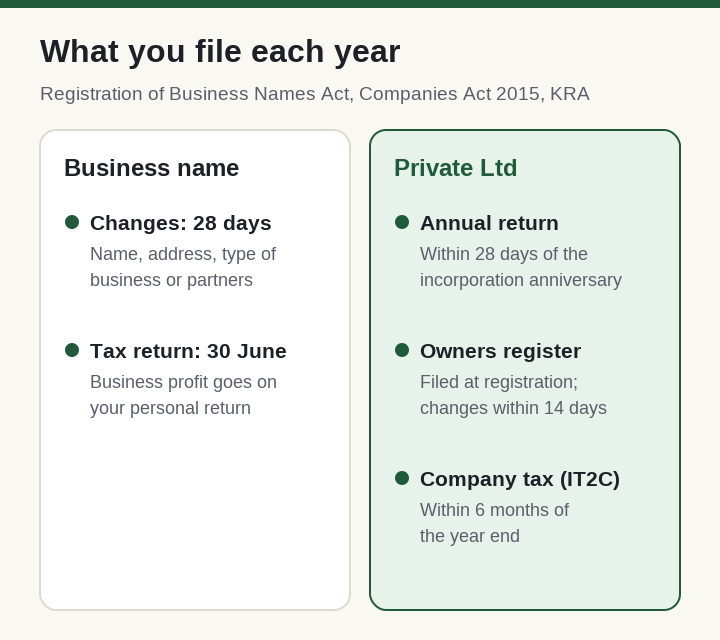
A business name has little yearly paperwork beyond updating changes. A company files an annual return with BRS every year and keeps official registers.
Business name:
- Tell BRS about any change in the name, address, type of business or partners within 28 days[5]. BRS charges KSh 200 or KSh 400 for a change of particulars[1].
- File your personal income tax return by 30 June[8].
Private limited company:
- Annual return. Every company lodges one each year, made up to the anniversary of incorporation, and within 28 days of that date[4]. You file it on eCitizen under “maintain a company”[3].
- Register of beneficial owners. Every company keeps one. A new company files its beneficial owners’ details with its registration documents, and any change goes to the Registrar within 14 days[9].
- Company tax return within six months of the year end[7].
Don’t let it slide. If a private company is late lodging a change, the company and each officer in default face an administrative penalty of KSh 2,000, plus KSh 100 for each day it continues[9].
How do you register each one, step by step?
Both are done online on eCitizen through BRS. The business name has fewer steps.
Business name:
- Shortlist three to five names. Run them through our business name checklist so the search isn’t rejected.
- Log in to eCitizen and open BRS. BRS points you to its online portal for registration[3].
- Search and reserve the name.
- Fill in your details and those of any partners, sign the form eCitizen generates, scan and upload it[3], then pay KSh 950[1].
- Download your certificate, usually in about a day[1].
Private limited company:
- Agree who owns what. Write down the shareholders and their split before you open the form.
- Pick at least one director who is a natural person[4].
- Search and reserve the company name on eCitizen.
- Sign the documents eCitizen generates for a private company (forms CR1, CR2, CR8 and a statement of nominal capital[1]), plus your beneficial owners’ details[9], then scan and upload them[3].
- Pay KSh 10,650 and wait 3 to 5 days for the certificate of incorporation[1].
- Keep your register of beneficial owners up to date. Its details go in with your application, and any later change must be filed within 14 days[9].
After either one: get a KRA PIN for the business where needed, your county business permit, and a bank account in the business name. Our guide on registering a business in Kenya covers that order.
What do you need in hand before you start?
Have these ready before you open eCitizen, so you finish in one sitting.
- An eCitizen account for every owner and director.
- KRA PINs for every owner and director (BRS says directors and shareholders must be on iTax), and a recent coloured passport photo for each company director or shareholder[3].
- Three to five name options, in order of preference[3].
- Your business address and a short description of what you do.
- For a company: the share split, each director’s details, and the beneficial owners’ details.
- Money to pay by M-Pesa or card: KSh 950 or KSh 10,650[1], or the total your eCitizen invoice shows.
Can you start as a business name and switch to a company later?
Yes, many people do. The company is a new legal person, so treat it as a fresh start rather than an upgrade.
The BRS fee schedule lists no fee for converting a business name into a private limited company, only into an LLP (KSh 25,000)[1].
On eCitizen, BRS’s route is “Cessation to Convert”: you file a cessation of the business name and choose the new business type. Once the cessation is approved, you fill in the new company’s details and pay[3].
So in practice you:
- Apply for “Cessation to Convert” on eCitizen, choose a private company and pay the cessation fee (KSh 800, subject to penalties)[3][1].
- Once it is approved, fill in the company’s details and pay. The fee schedule lists KSh 10,650 for registering a private company[1], so check the total eCitizen shows[3].
- Move things across: bank account, contracts, supplier accounts, KRA registrations, permits.
- Tell your customers the new name and payment details, in writing.
Every contract and every customer you move costs time. If you can already see the company coming within a year, it’s often simpler to start with one.
Tips from how it really works
- Personal guarantees cut through “limited”. If a bank or landlord asks you to sign a personal guarantee, you are personally liable for that debt, company or not. Read before you sign.
- Keep business money separate from day one, whichever you pick. It makes tax time and loans easier. See how to manage cash flow.
- Check before you pay an agent. After registration, run your own official search (KSh 650 for a company[1]). The CR12 shows who BRS has on record as directors[1].
- Put the annual return date in your phone the day your certificate arrives. Our compliance calendar has the KRA dates.
Don’ts
- Don’t pick a company just to look big. It brings yearly filings and costs. If your risk is small, start simple.
- Don’t stay a business name once the stakes grow. One bad contract can reach your plot, car or savings[2].
- Don’t let an agent list themselves as an owner unless that’s the deal. Check the CR12.
- Don’t ignore the 28-day rules. They apply to business name changes and to company annual returns[5][4].
Common mistakes, and what to do instead
Registering a company and forgetting it exists. Annual returns pile up. Instead, diarise the return date and file every year[4].
Mixing personal and company money. It blurs the separation you paid for. Instead, open a company account and pay yourself properly.
Assuming TOT is always cheaper. It taxes sales, with no expenses deducted[6]. Instead, run the numbers with an accountant if your margins are thin.
Using a business name for a two-founder venture with no agreement. Fall-outs get messy. Instead, register a company with a clear share split, or at least sign a written partnership agreement.
Your quick checklist
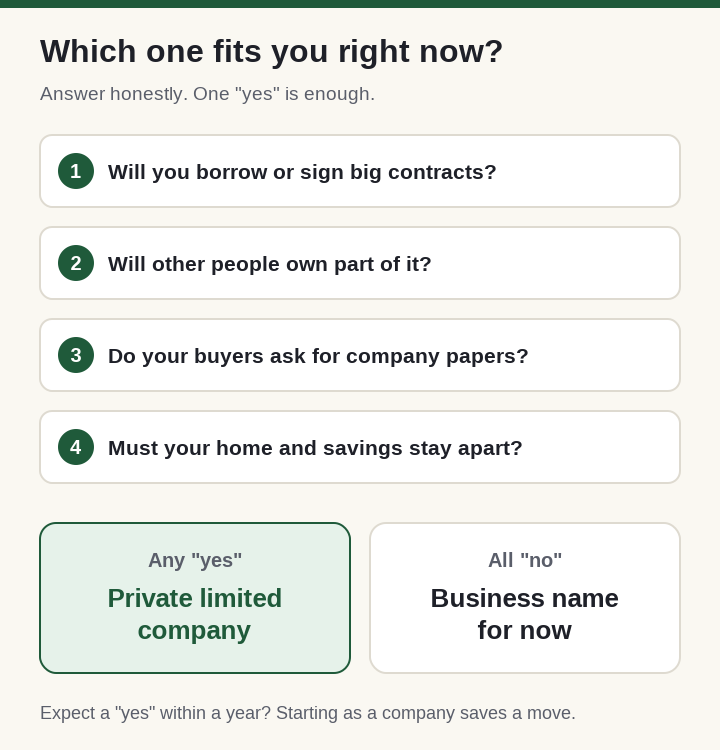
- Will I borrow, sign big contracts or take investors? If yes, lean towards a company.
- Do my buyers ask for company documents? If yes, lean towards a company.
- Can I carry the business’s debts personally? If not, lean towards a company.
- Business name: KSh 950, about 1 day[1].
- Company: KSh 10,650, 3 to 5 days, one natural person director at least[1][4].
- Company yearly: annual return, beneficial owners changes within 14 days, IT2C[4][9][7].
- Sales between KSh 1 million and 25 million? Look at Turnover Tax[6].
Whichever you choose, the certificate is only the start. Buyers still need to find you and trust you. Once you’re registered, a complete Biashara Pros business page with your prices and a named contact helps buyers who are already searching.
Common questions
Can one person register a limited company in Kenya?
Yes. The Companies Act, 2015 lets one or more persons form a company, and a private company needs only one director, who must be a natural person. The same person can be the only shareholder and the only director.
Do I need to register a business name if I trade under my own name?
Not always. The Registration of Business Names Act requires registration when an individual trades under a name that is not their surname plus forenames or initials. "Wanjiru Kamau" needs no registration; "Wanjiru Kamau Designs" does.
How long does registration take on eCitizen?
The BRS fee schedule gives about 1 day for a business name and 3 to 5 days for a private limited company, once the application is complete.
Does a limited company need a company secretary?
Only once its paid-up capital reaches KSh 5 million. Below that, a private company does not need a secretary, and a director can do the secretary's tasks.
How much does an official search cost on BRS?
KSh 250 for a business name and KSh 650 for a company, according to the BRS fee schedule. The company search gives you the CR12, the official search certificate BRS uses for company background checks.
How many shareholders can a private limited company have?
BRS says membership of a private company is restricted to a maximum of 50 members, and a private company cannot invite the public to buy its shares.
Can a business name pay Turnover Tax?
Yes. KRA says any resident person or corporate with a gross turnover of more than KSh 1 million and not more than KSh 25 million a year is eligible for Turnover Tax, at 1.5% of gross sales. A company in that range is eligible too. TOT does not cover rental income or management, professional or training fees.
Sources
- BRS: Fee Schedule, Companies Registry
"Registration of Business name | Kshs 950 ... Private Limited Company | Kshs 10,650 ... 3-5 days"
- BRS: Entities registered under BRS in Kenya
"The Business Name is not a legal entity. It simply refers to a person who owns the business and is personally responsible for its debts."
- BRS: Frequently Asked Questions (PDF)
"A Business Name is not a legal entity. It costs Kshs. 950 to register."
- Companies Act, 2015 (Revised Edition 2021), as published by BRS (PDF; section 93A has since been replaced, see source 9)
"A private company is required to have at least one director. ... A company is required to have at least one director who is a natural person."
- Registration of Business Names Act, Cap. 499 (Revised Edition 2019), as published by BRS (PDF)
"shall be furnished within twenty-eight days after the firm, individual or corporation commences business under or commences to use the business name"
- KRA: Turnover Tax (TOT)
"Any resident person or corporate whose gross / expected turnover is more than Kshs. 1,000,000 but does not exceed or expected to exceed Kshs. 25,000,000 in any year of income is eligible for Turnover Tax."

- KRA: Filing and paying taxes (companies and partnerships)
"Resident Companies are taxed at a rate of 30%."

- KRA: Individual Income Tax
"Income tax is a direct tax that is imposed on income derived from Business, Employment, Rent, Dividends, Interests, Pensions among others."
- Anti-Money Laundering and Combating of Terrorism Financing Laws (Amendment) Act, 2023, new section 93A of the Companies Act, as published by BRS (PDF)
"A company shall lodge with the Registrar a copy of its register of beneficial owners (a) in the case of a proposed company, when submitting documents as provided for under section 13 of this Act ... A company, other than a public listed company, shall lodge with the Registrar a copy of any amendment to its register of beneficial owners within fourteen days after making the amendment."
This is general information, not advice for your situation. Rules and rates change with each Finance Act. Before a decision with real money at stake, confirm with a licensed accountant or advocate. Spotted something out of date? Tell us at support@biasharapros.com and we will fix it.