Pricing & Margin
Festive Discounts That Grow Your Profit, Not Just Your Sales
Before you cut prices this December, work out how many extra sales a discount needs, which items to hold, honest sale rules and how VAT works on a discount.
Biashara Pros editorial team 13 min read
Facts checked against official sources on 10 November 2026. How we check facts

A festive discount pays only when the extra sales it brings cover the profit you give away. On an item with a 30% margin, 10% off means you must sell half as many again just to stand still. So discount slow stock, use bundles for gifts, hold prices on your best sellers, and keep every “was” price true.
December feels like the month to cut prices. Everyone else seems to be doing it.
But a busy December with thin margins can leave you with less money in January than a calm month at fair prices. Let’s work out when a discount helps you, and when it quietly eats your profit.
How much more do you need to sell after a discount?
More than most people guess. A discount comes straight out of your profit, not out of your price, so the cut to your profit is much bigger than the number on the sign.
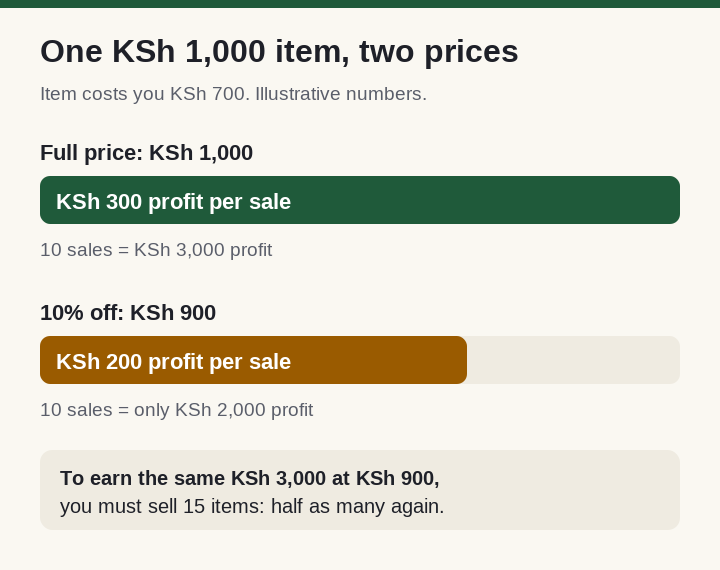
Here’s a simple example. Say an item costs you KSh 700 and you sell it for KSh 1,000.
- Full price: you keep KSh 300 per sale. Ten sales give you KSh 3,000.
- 10% off (KSh 900): you keep KSh 200 per sale. Ten sales give you only KSh 2,000.
To earn the same KSh 3,000 at KSh 900, you need 15 sales instead of 10. That’s 50% more sales, more stock, more packing and more delivery runs, for the same money.
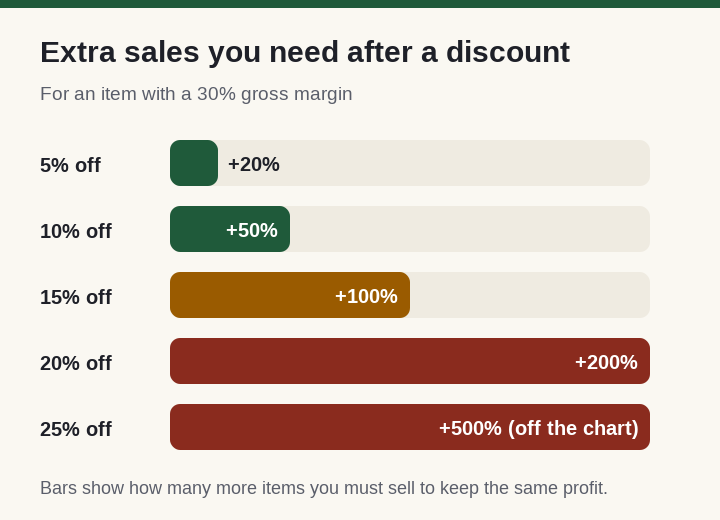
The rule behind it is simple. Divide your margin by (your margin minus the discount). That gives you how many times your normal sales you need.
| Your margin | 5% off | 10% off | 15% off | 20% off | 25% off |
|---|---|---|---|---|---|
| 20% | +33% | +100% | +300% | No profit left | Loss |
| 30% | +20% | +50% | +100% | +200% | +500% |
| 40% | +14% | +33% | +60% | +100% | +167% |
| 50% | +11% | +25% | +43% | +67% | +100% |
Extra sales needed to keep the same gross profit. Illustrative maths, before VAT and other selling costs.
Look at the 20% row. If your margin is thin, even a small discount needs a flood of new buyers that rarely comes.
What is the difference between margin and markup?
Margin is your profit as a share of the selling price. Markup is your profit as a share of what the item cost you.
They sound alike, and mixing them up is where many price lists go wrong.
Take that KSh 700 item sold at KSh 1,000. The profit is KSh 300.
- Markup: 300 ÷ 700 = about 43%.
- Margin: 300 ÷ 1,000 = 30%.
So when someone says “I add 50% to my cost”, their margin is only about 33%. Use margin in the table above, never markup.
Not sure of your true cost per item? Our guide to pricing for Kenyan businesses walks through adding transport, packaging and overheads.
When does a festive discount actually help?
A discount helps when it brings in money you would not get otherwise, and costs you less than it brings.
These are the cases where it usually works:
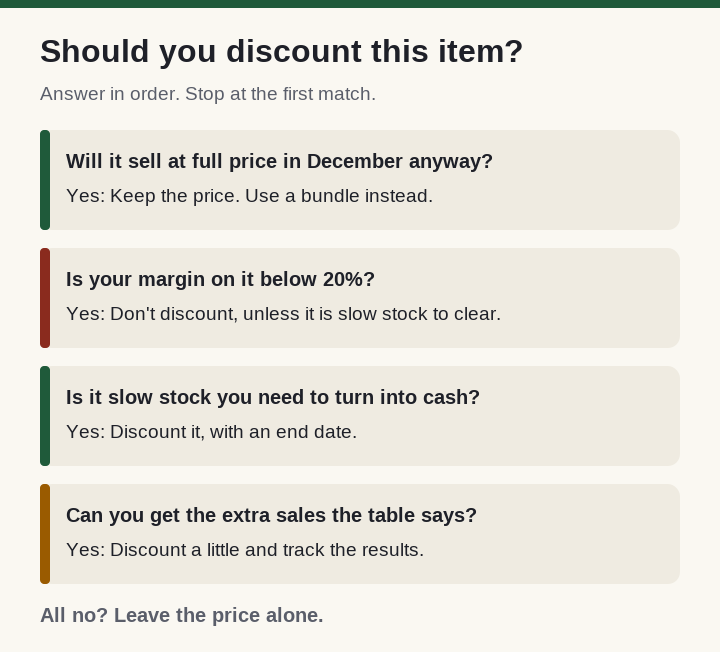
- Slow stock that is tying up cash. Last season’s styles, items near their best-before date, or stock you over-ordered. Cash in January beats goods on a shelf in March.
- Bundles that move a slow item with a fast one. The fast seller keeps its price; the slow one rides along.
- Early orders that bring cash forward. A small “order before 30 November” offer for gift hampers or uniforms lets you buy stock with the customer’s money, not yours.
- Larger orders from business buyers. An office ordering 50 gift packs saves you 49 separate sales, deliveries and M-Pesa checks. A volume price can still leave you better off.
- Quiet hours or days. A salon or car wash with empty mid-week slots can offer those slots for less, without touching the busy Saturday price.
In every case, set an end date and keep it.
When does a discount eat your profit?
A discount eats your profit when people would have paid full price anyway.
Watch out for these:
- Best sellers in peak weeks. If an item flies off the shelf in December at full price, a discount just gives your profit away.
- Thin-margin items. At a 20% margin, 10% off means you must double your sales to stand still.
- “Everything 20% off” signs. A blanket cut hits your best items as hard as your worst.
- Services that are already fully booked. A caterer, tent hirer or make-up artist with every December weekend taken has no room for extra jobs. A discount only lowers the price of work you already have.
- Discounts that never end. Customers learn to wait for the next sale, and your normal price stops meaning anything.
What can you offer instead of cutting the price?
Give more value, not a lower price. Customers in December want gifts that look good, arrive on time and are easy to buy.
Try these before you reach for the discount sticker:
- Gift packs and party packs. Put three or four items together at one clear price. It raises the size of each sale.
- Free gift wrapping or a card. It costs you little and saves the buyer a trip.
- Free delivery above a set amount. “Free delivery in town on orders over KSh 3,000” pushes people to add one more item.
- A small free extra. A sample, a refill or a matching accessory feels generous and costs you only what you paid for it.
- A January voucher. “Spend KSh 2,000 now, get KSh 200 off in January” brings the customer back in your quietest month.
Each of these protects the price of your best sellers, which usually earn most of your profit.
What does Kenyan law say about sale prices and “was / now” offers?
Your sale has to be true. A fake “was” price can break two laws, and advertising a deal you can’t supply can break one of them.
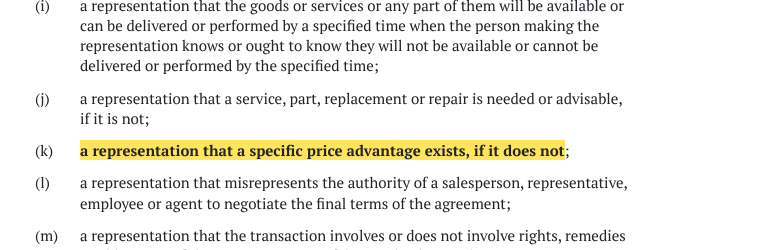
The Consumer Protection Act, 2012 lists “a representation that a specific price advantage exists, if it does not” as a false, misleading or deceptive representation[3].
The same section covers saying goods are available when you know, or ought to know, they are not[9]. So advertising a deal you have only two of, to pull people in, is risky.
What can the customer do? The Act says an agreement made after or while a business has engaged in an unfair practice may be rescinded by the consumer, who is entitled to any remedy in law, including damages[4].
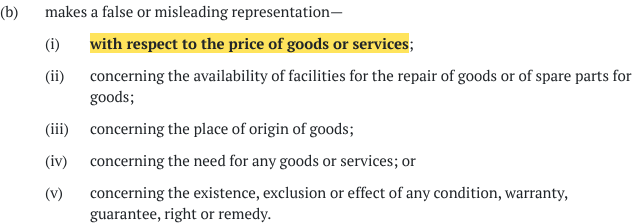
The Competition Act goes further. Making a false or misleading representation “with respect to the price of goods or services” is an offence[1].
A person convicted of an offence under that part of the Act faces up to five years in prison, a fine of up to KSh 10 million, or both[2].
In plain words:
- Only show a “was” price you really charged.
- Say what the offer covers: which items, which sizes, until when.
- Have enough stock for the deal you advertise, or say how many you have.
- Keep the end date you announced.
How do VAT and Turnover Tax work on a discounted sale?
If you are registered for VAT, you charge VAT on the discounted price, as long as the discount is given at the time of the sale. If you pay Turnover Tax, it is 1.5% of what you actually sell for.
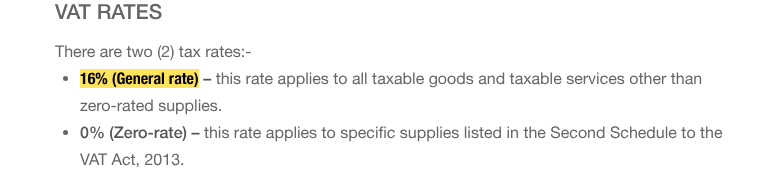
VAT. KRA’s general VAT rate is 16%[6]. You must register once your taxable sales reach KSh 5 million or more in a year[6].
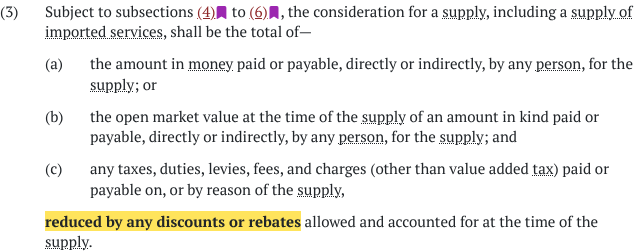
The VAT Act, 2013 says the value you charge VAT on is “reduced by any discounts or rebates allowed and accounted for at the time of the supply”[5].
Worked example. An item is KSh 1,000 before VAT, so KSh 1,160 with 16% VAT[6]. With 10% off at the till:
- New price before VAT: KSh 900
- VAT at 16%: KSh 144
- Customer pays: KSh 1,044
Show the discounted price on the invoice, so your records match what the customer paid. Our VAT calculator does the sums for any price.
One more thing. Do your margin maths on prices before VAT. The VAT is not your money, so it doesn’t belong in your profit.
Turnover Tax (TOT). KRA charges TOT at 1.5% on gross sales[7]. A KSh 900 sale means KSh 13.50 of TOT instead of KSh 15.
That’s a small saving. Your profit on the same sale fell by KSh 100. Because TOT is on sales, not profit, it never makes up for a discount. Our Turnover Tax vs VAT tool helps you compare the two.
How do you set your festive prices, step by step?
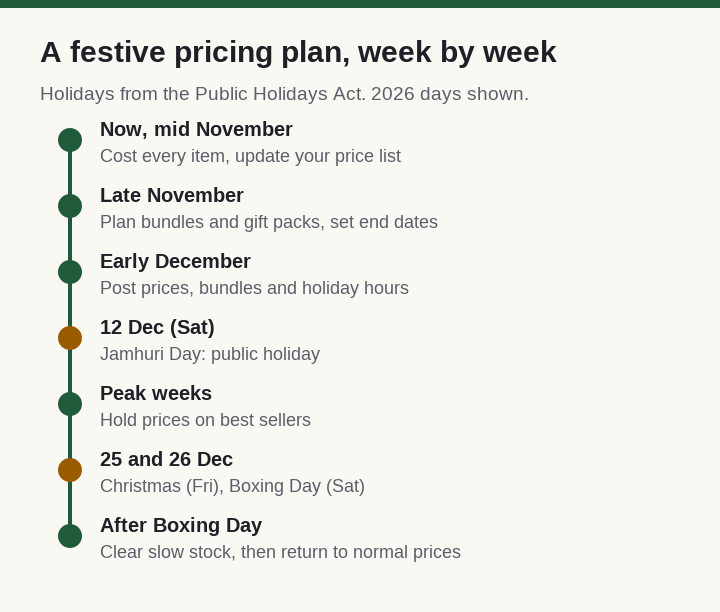
Do it now, in November, before the rush. You’ll make calmer decisions than you will at the counter on 23 December.
- List your top 20 items by profit made last December, not by number sold.
- Work out the margin on each (selling price before VAT, minus your full cost per item).
- Mark each item: hold, bundle or clear. Best sellers get “hold”. Slow stock gets “clear”.
- Update your price list if your costs have gone up since last year. Do it now, not mid-December.
- Build two or three bundles for gifts or parties, each with one clear price.
- Set discounts only on “clear” items, check the table above, and write down the end date.
- Post your prices in the shop, in your catalogue and on your WhatsApp status, with the offer’s terms.
- Count what each offer brings in every week. Drop any that isn’t paying.
What do you need in place before you announce an offer?
Have your numbers, your proof and your offer terms written down before anything goes up.
- Your true cost for each item, including transport, packaging and payment charges
- The margin on each item, worked out on prices before VAT
- The “was” price records, showing you really charged it[3]
- Enough stock for the offer, or a stated quantity[9]
- A written end date and the items the offer covers
- An invoice that shows the discounted price, if you are VAT registered[5]
How does December trading really work in Kenya?
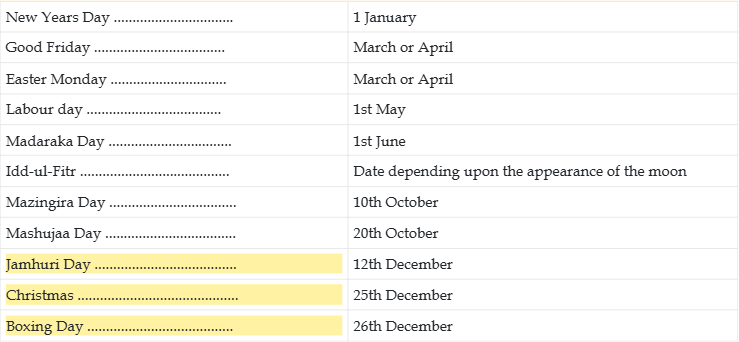
- Plan around the holidays. Jamhuri Day is 12 December, Christmas 25 December and Boxing Day 26 December[8]. In 2026 they fall on a Saturday, a Friday and a Saturday.
- Buyers travel upcountry. Many people shop for gifts before they leave town, so your strongest weeks may come before the Christmas weekend, not on it.
- Show prices in your WhatsApp catalogue. Buyers who can see prices ask fewer questions and decide faster.
- Clear slow stock after Boxing Day. Once the gift rush is over, a clearance on leftovers turns them into January cash.
- Plan for January. Rent, school fees season and January’s tax payments all come after the rush. See how to manage cash flow.
What should you never do with festive prices?
- Don’t discount your best sellers in peak weeks. You give away profit on sales you would have made anyway.
- Don’t invent a “was” price. The law treats a price advantage that doesn’t exist as a false representation[3].
- Don’t advertise stock you don’t have. It can be a false representation under the Consumer Protection Act[9], and customers who leave with nothing don’t come back.
- Don’t change a price at the counter after you’ve quoted it. It kills trust in December’s busiest moments.
- Don’t count VAT as profit when you work out what you can afford to cut.
Which festive pricing mistakes cost the most?
Using markup in place of margin. You think you have more room than you do. Instead, work out margin on the selling price.
One discount for everything. Instead, hold your best sellers and discount only slow stock.
No end date. The sale drags into February and customers wait for the next one. Instead, set the end date before you start and keep it.
Not tracking results. You can’t tell which offer worked. Instead, count weekly sales and profit for each offer.
Forgetting the cost of the discount. Instead, multiply the money off by the units you expect to sell. The profit on your extra sales has to beat that figure.
What does a discount really cost, and when should you act?
The money a discount gives away is the money off multiplied by every unit you sell at that price, including units that would have sold at full price.
The offer pays only if the profit on your extra sales is bigger.
Example: 10% off a KSh 1,000 item that costs you KSh 700, and you sell 40 of them. You give away KSh 4,000 in price.
If 30 of those 40 would have sold anyway, the discount on those 30 cost you KSh 3,000. The 10 extra sales earned only KSh 2,000 (KSh 200 each). You end up KSh 1,000 worse off than with no offer.
| When | What to do |
|---|---|
| Now (mid November) | Cost every item, update your price list |
| Late November | Plan bundles and gift packs, set end dates |
| Early December | Post prices, bundles and holiday hours |
| 12, 25 and 26 December | Public holidays[8]: plan opening hours and stock |
| After Boxing Day | Clear slow stock, then return to normal prices |
What should be on your festive pricing checklist?
- Top 20 items listed, by profit made last December.
- Margin worked out for each, before VAT.
- Each item marked hold, bundle or clear.
- Price list updated before December.
- Two or three bundles built, each with one price.
- Discounts only on “clear” items, each with an end date.
- Every “was” price real, every offer in stock[3][9].
- VAT charged on the discounted price, if you are registered[5].
- Weekly count of what each offer brings in.
Buyers in December compare prices before they call anyone. If you have a Biashara Pros business page, put your festive prices and bundles there too, so they can see them before they ask.
Common questions
Is it legal to advertise "was KSh 2,000, now KSh 1,500"?
Yes, if it is true. The Consumer Protection Act lists a representation that a specific price advantage exists, when it does not, as a false, misleading or deceptive representation. Only show a "was" price you really charged.
Do I charge VAT on the full price or the discounted price?
On the discounted price, if the discount is given at the time of the sale. The VAT Act, 2013 says the consideration for a supply is reduced by any discounts or rebates allowed and accounted for at the time of the supply.
If I add 50% to my cost, is my margin 50%?
No. Adding 50% to your cost is a 50% markup, which is a margin of about 33%, because margin is profit as a share of the selling price. An item that costs KSh 700 and sells for KSh 1,000 has a markup of about 43% but a margin of 30%.
Can a customer cancel a purchase made because of a false discount?
The Consumer Protection Act says a consumer may rescind an agreement entered into after or while a person has engaged in an unfair practice, and is entitled to any remedy available in law, including damages.
Does a discount lower my Turnover Tax?
Turnover Tax is 1.5% of gross sales, so a lower selling price means slightly less tax. But because the tax is on sales, not profit, your profit falls much faster than your tax does.
What is the penalty for misleading price claims in Kenya?
Under the Competition Act, a false or misleading representation about the price of goods or services is an offence. A person convicted of an offence under that Part faces up to five years in prison, a fine of up to ten million shillings, or both.
Should I put up my prices in December?
Only if your costs have gone up. Update your price list before the rush, show it clearly, and never change a price at the counter after you have quoted it.
Sources
- Competition Act (Cap. 504), section 55, Kenya Law
"makes a false or misleading representation— (i) with respect to the price of goods or services"
- Competition Act (Cap. 504), section 70 (offences and penalty), Kenya Law
"A person who contravenes any of the provisions of this Part commits an offence and shall be liable on conviction to imprisonment for a term not exceeding five years, or to a fine not exceeding ten million shillings, or both."

- Consumer Protection Act, 2012, section 12 (false representation), Kenya Law
"a representation that a specific price advantage exists, if it does not"
- Consumer Protection Act, 2012, section 16 (rescinding agreement), Kenya Law
"Any agreement, whether written, oral or implied, entered into by a consumer after or while a person has engaged in an unfair practice may be rescinded by the consumer"
- Value Added Tax Act, 2013, section 13 (taxable value of supply), Kenya Law
"reduced by any discounts or rebates allowed and accounted for at the time of the supply."
- KRA: Value Added Tax
"16% (General rate) – this rate applies to all taxable goods and taxable services other than zero-rated supplies."
- KRA: Turnover Tax (TOT)
"It is payable at the rate of 1.5% on gross sales effective from 1st of July 2023 as per Finance Act 2023."

- Public Holidays Act (Cap. 110), Schedule, Kenya Law
"Jamhuri Day ... 12th December. Christmas ... 25th December. Boxing Day ... 26th December"
- Consumer Protection Act, 2012, section 12(2)(h) (availability), Kenya Law
"a representation that the goods or services or any part of them are available or can be delivered or performed when the person making the representation knows or ought to know they are not available"

This is general information, not advice for your situation. Rules and rates change with each Finance Act. Before a decision with real money at stake, confirm with a licensed accountant or advocate. Spotted something out of date? Tell us at support@biasharapros.com and we will fix it.