Legal
Keep Customer Data Safe and Avoid ODPC Fines
Data protection for Kenyan small businesses: who must register with the ODPC, the fees, consent for promotions, breach rules and a checklist you can use.
Biashara Pros editorial team 15 min read
Facts checked against official sources on 22 November 2026. How we check facts

If your business keeps customer names, phone numbers, ID numbers or M-Pesa details, Kenya’s Data Protection Act applies to you. You must tell people why you collect their data, keep it secure, delete it when you’re done and report serious breaches within 72 hours. Many must also register with the Office of the Data Protection Commissioner (ODPC), from KSh 4,000.
Think about what’s on your phone right now.
A WhatsApp list of 600 customers. A notebook of deliveries with names and estates. Screenshots of M-Pesa messages. Maybe CCTV footage from the shop.
That’s personal data. And the law has rules for it.
This guide walks you through those rules in plain words, so you can start fixing the gaps this afternoon.
What counts as customer data under the Data Protection Act?
Any information about a person who can be identified. The Data Protection Act defines personal data as “any information relating to an identified or identifiable natural person”[1].
So a name and phone number is personal data. So is a delivery address, an ID number, a photo, or a CCTV clip of a face.
The Act calls you a data controller if you decide why and how that data is used[1]. A data processor is someone who handles it on your behalf, like the firm that hosts your website or runs your SMS system[1].
What is sensitive personal data?
Some data gets extra protection. The Act lists race, health status, ethnic social origin, beliefs, genetic and biometric data, property details, marital status, family details and sex or sexual orientation as sensitive[1].
A pharmacy’s prescription records, a gym’s fingerprint scanner and a school’s family details all sit in this group.
Do you have to register with the ODPC?
It depends on your sector, turnover and staff. The Act says no one shall act as a data controller or processor unless registered, but lets the Data Commissioner set thresholds[1].
Under the Registration Regulations, you are exempt from registration only if your annual turnover is below KSh 5 million and you have fewer than 10 employees[7].
There’s a catch. Some sectors must register whatever their size. The Third Schedule lists, among others[7]:
- Crime prevention, including operating a security CCTV system
- Hospitality firms (tour guides excluded)
- Operating an educational institution
- Health administration and patient care
- Property management, including selling land
- Financial services
- Transport services, including ride-hailing apps
- Businesses that are wholly or mainly in direct marketing
That CCTV line can catch shops, salons and offices that run security cameras. If you have them, read it twice.
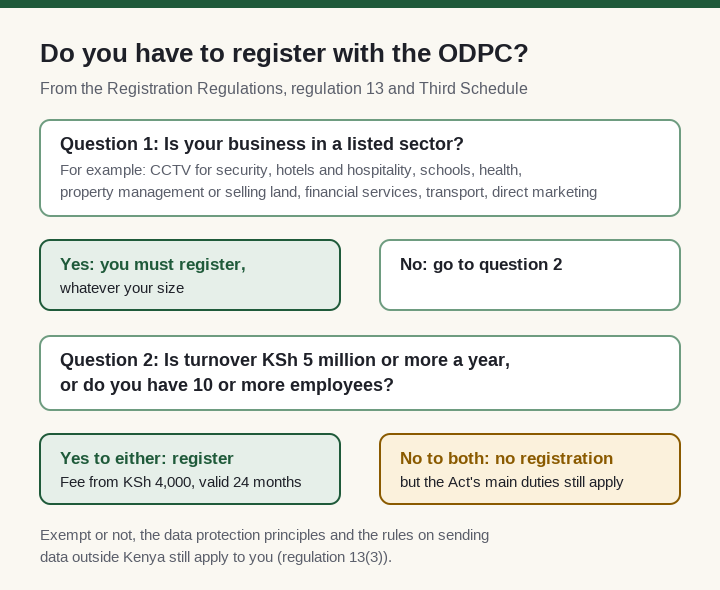
Exempt doesn’t mean off the hook. The Regulations say exempt businesses must still comply with Part IV of the Act (the principles and duties) and Part VI (sending data outside Kenya)[7].
How do you register, step by step?
Registration is online through the ODPC’s data portal, linked from its home page as “Register as a Data Handler”[14]. The Regulations say applications go through the electronic means on the Office website[7].
- Decide your role. Most businesses register as a data controller. If you also handle data for clients, such as an IT firm or a payroll bureau, you may need to register as a processor too[7].
- Gather your establishment documents. For most businesses that is your registration certificate[7]. If you haven’t registered the business yet, start with our guide on registering a business in Kenya.
- List your data. Form DPR1 asks for each group of people (customers, staff, suppliers), what data you hold on them and why[7].
- Note any sensitive data and why you need it[7].
- Pay the fee for your category (see the next section)[8].
- Wait for the certificate. Once satisfied, the Data Commissioner issues it within 14 days[7].
- Diarise the renewal. The certificate is valid for 24 months[7].
If your details change, such as your address or the kind of data you collect, tell the Data Commissioner in writing within 14 days[7].
What does ODPC registration cost?
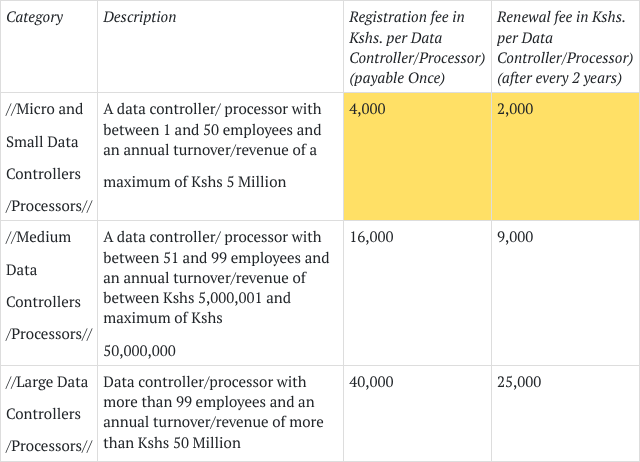
KSh 4,000 for most small businesses, then KSh 2,000 every two years to renew. The Second Schedule of the Registration Regulations sets these fees[8]:
| Category | Who it covers | Register (once) | Renew (every 2 years) |
|---|---|---|---|
| Micro and small | 1 to 50 employees, turnover up to KSh 5 million | KSh 4,000 | KSh 2,000 |
| Medium | 51 to 99 employees, KSh 5 million to 50 million | KSh 16,000 | KSh 9,000 |
| Large | Over 99 employees, over KSh 50 million | KSh 40,000 | KSh 25,000 |
| Public, charity, religious | Regardless of size | KSh 4,000 | KSh 2,000 |
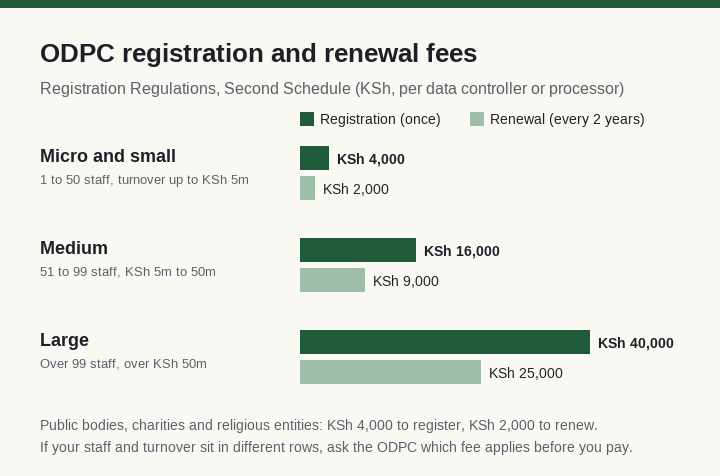
Tip: the schedule pairs staff numbers with turnover. A business with 15 staff and KSh 8 million turnover fits neither row neatly. Ask the ODPC which fee applies before you pay.
Registering as both controller and processor means paying the fees for both[7].
What must you tell customers before you collect their data?
Why you want it, who else gets it, and what their rights are. Section 29 says you must, before collecting data and as far as practicable, tell the person[2]:
- That you are collecting their data, and for what purpose
- Their rights under the Act
- Any third parties who will receive it, and the safeguards you use
- Your contact details
- How you keep the data secure
- Whether giving it is voluntary or required, and what happens if they don’t
You also have to collect data directly from the person in most cases[2], and only collect what you need for that purpose[2].
In practice, that’s a short notice on your order form, website or the first WhatsApp message. One clear paragraph is enough for most small businesses.
The General Regulations also ask you to publish a data protection policy and keep it updated. It may cover what you collect, how people can use their rights, how you handle complaints and how long you keep data[11].
Can you send promotions to your customers’ numbers?
Only with a clear yes, and an easy way out. Section 37 says you can’t use personal data for commercial purposes unless you have the person’s express consent, or a written law allows it and you told them when collecting it[3].
The General Regulations spell out direct marketing. You may use a customer’s data (not sensitive data) for marketing where you collected it from them, told them marketing was a purpose, they consented, and they haven’t opted out[10].
Consent has to be real. The Act defines it as an “express, unequivocal, free, specific and informed” indication of the person’s wishes[1]. The Regulations say consent is not freely given where it is assumed because the person didn’t object, or bundled as a non-negotiable part of your terms[9].
And you carry the burden of proving consent[3]. So keep a record: the date, the message and how they said yes.
What makes a good opt-out?
The Regulations say every marketing message must show how to opt out, and the process must take minimal time and effort and be free or cost only a nominal amount[10].
Examples the Regulations give:
- Reply with a single word to a text message to stop[10]
- A clear unsubscribe link in an email[10]
- Telling someone on a sales call they can opt out out loud[10]
Once someone opts out, you stop[10]. Using data for marketing without consent is an offence, with a fine of up to KSh 20,000 or up to six months in prison, or both[10].
A “STOP” reply is the simplest test. If a customer replies STOP and you keep sending, you have a problem.
For a wider look at keeping customers coming back without spamming them, see our guide on getting and keeping customers.
How do you keep customer data secure?
Use safeguards that fit the risk, and check they work. Section 41 asks you to identify reasonably foreseeable risks to the data, put safeguards in place, consider encryption, be able to restore access after an incident, and keep updating your safeguards[4].
For a small business, that looks like this:
- A PIN or password on every phone and laptop that holds customer data.
- No shared logins. Each staff member has their own, so you know who did what.
- Limit access. The cashier doesn’t need the full customer list.
- Back up your records so a stolen phone doesn’t wipe out your business.
- Remove access the day a staff member leaves.
- Train your staff. The Act says you must take reasonable steps so anyone working for you follows your security measures[4].
What about your IT and cloud providers?
If someone handles data for you (a web developer, a cloud host, a bulk SMS firm, a payroll bureau), you need a written contract with them. The Act says it must make them act only on your instructions[4].
The General Regulations list what goes in it: what data and for how long, your instructions, confidentiality, security measures, deleting or returning the data when the contract ends, and your right to audit them[11].
How long can you keep customer data?
Only as long as you reasonably need it, unless a law requires you to keep it longer[2].
The General Regulations ask you to set a retention schedule: why you keep each type of data, for how long, when you review it and what happens after the review[11]. When the purpose ends, you erase, delete, anonymise or pseudonymise it[11].
The Act allows longer retention where a law requires or authorises it[2]. So records that other laws make you keep, such as tax records, stay for as long as those laws say. Delete the rest.
What rights do your customers have?
To know, see, correct, delete and object. Section 26 gives every person the right to be told how their data is used, to access it, to object to its use, and to have false or misleading data corrected or deleted[2].
The General Regulations set the clock[9][10]:
- Access to their data: within 7 days, free of charge
- Correction of wrong data: within 14 days, free
- Erasure: respond within 14 days, free
- Stop sharing for third-party marketing: within 7 days
- Port their data to another provider: within 30 days, for a fee no higher than your cost
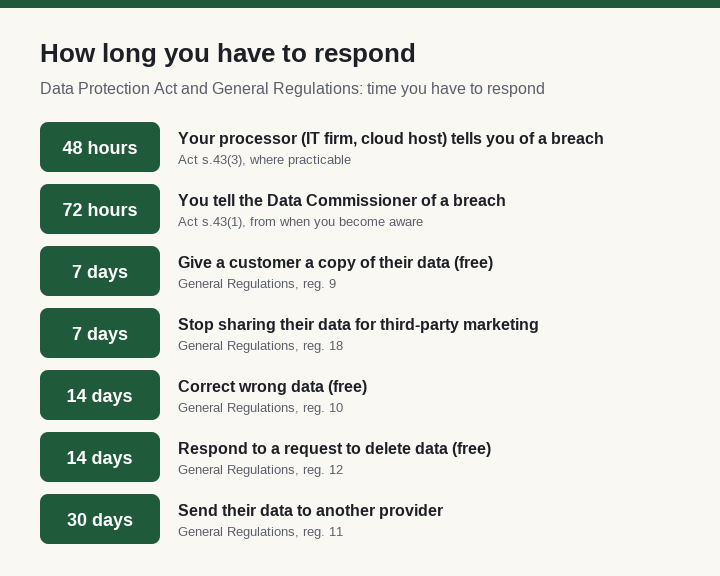
Seven days goes fast. Know where your data lives, so you can find one person’s records quickly.
What do you do if customer data leaks?
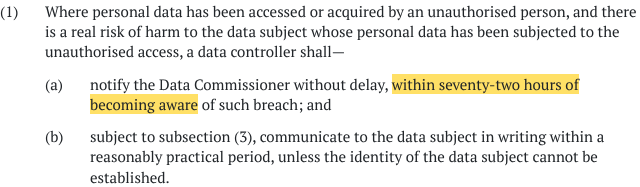
Act fast, record everything and report within 72 hours if people are at real risk. Section 43 says where data has been accessed by someone unauthorised and there’s a real risk of harm, you must notify the Data Commissioner within 72 hours of becoming aware, and tell the affected people in writing within a reasonably practical period[5].
If you report late, you must give reasons for the delay[5]. If your IT provider discovers the breach, they must tell you without delay, and where reasonably practicable within 48 hours[5].
When is a breach serious enough to report?
The General Regulations say there is real risk of harm where the breach involves a person’s full name or ID number together with financial details listed in the Regulations, such as their pay, card or bank account number, deposits and withdrawals, loans, debts or payments received. An account name or number together with a password, PIN or security code also counts[12].
For a business holding M-Pesa records or customer debts, that test is easy to meet.
Here’s what to do, in order:
- Contain it. Change passwords, revoke access, recover the device if you can.
- Write down what happened, its effects and what you did. The Act requires this record for every breach[5].
- Decide if it’s notifiable using the test above.
- Report to the ODPC within 72 hours. Its home page has a “Report A Data Breach” link[14].
- Tell your customers what happened, what you’ve done and what they should do to protect themselves[5].
What happens if you ignore the law?
Fines, compensation claims and a damaged name. The Data Commissioner can issue a penalty notice of up to KSh 5 million, or 1% of annual turnover for a business, whichever is lower[6].
A penalty notice can also add a daily fine of up to KSh 10,000 per breach until you fix it[13].
Customers can claim compensation for damage, which the Act says includes distress, not just money lost[6]. Offences without a specific penalty carry a fine of up to KSh 3 million or up to 10 years in prison, or both[6].
Complaints are easy for customers to make. They are free, and can be made by email, online, orally or even anonymously[13]. Once admitted, you get 21 days to respond[13].
Must-haves before you collect your next phone number
- A short privacy notice on forms, your website and first messages[2]
- A published data protection policy[11]
- ODPC registration if your sector, turnover or staff numbers require it[7]
- A written record of marketing consent[3]
- Written contracts with anyone who handles data for you[11]
- A retention schedule[11]
- A one-page breach plan naming who reports to the ODPC[5]
Tips from how it works in Kenya
- Use WhatsApp Business labels and broadcast lists carefully. Only add people who agreed to hear from you.
- Put the renewal date beside your KRA dates. Our KRA deadline calendar helps you keep one list.
- Ask for less at the till. If you don’t need an ID number for a delivery, don’t take it.
- Add the privacy line to your eTIMS and invoicing flow. Our guide on eTIMS invoices covers what buyers need from you.
- Doing something high-risk? Large-scale processing, biometrics or children’s data need a data protection impact assessment first[12].
What should you never do?
- Don’t buy or sell customer lists. Offering to sell unlawfully obtained data is an offence, and an advert saying data is for sale counts as an offer[6].
- Don’t add people to a promotions group without asking.
- Don’t share customer details with another business without telling customers first[2].
- Don’t ignore a customer’s request for their data. You have 7 days[9].
- Don’t sit on a breach hoping nobody notices.
Common mistakes that cost businesses
Thinking small means exempt. The CCTV, hospitality, education, health and property rules apply whatever your size[7]. Instead, check the Third Schedule list first.
Treating silence as consent. “Reply NO if you don’t want offers” isn’t consent[9]. Instead, ask for a yes.
Keeping everything forever. Old data is risk with no return. Instead, set a retention schedule and delete on time[11].
No contract with the web developer. If they mishandle your customers’ data, you can still be liable for the damage[6]. Instead, sign a written data contract[4].
Forgetting to renew. Certificates last 24 months[7]. Instead, set a reminder three months before.
Your data protection checklist
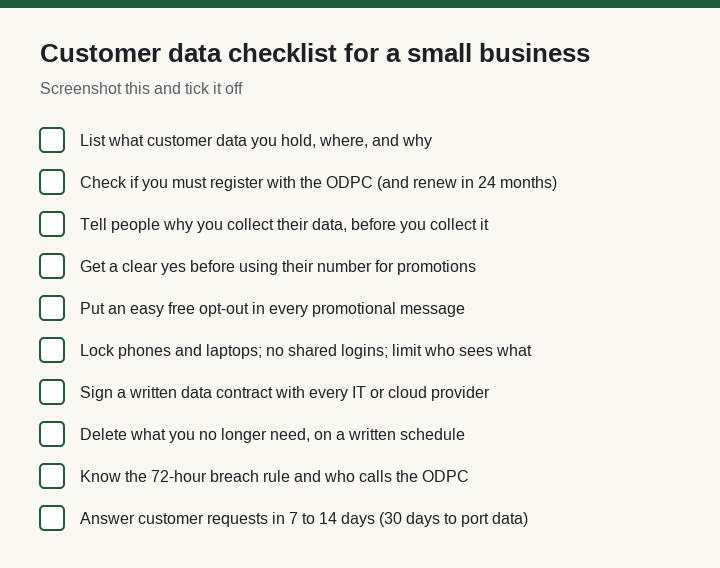
- List what customer data you hold, where and why.
- Check if you must register with the ODPC.
- Publish a short privacy notice and policy.
- Get a clear yes before sending promotions.
- Put a free, easy opt-out in every promotion.
- Lock devices and give each person their own login.
- Sign data contracts with IT and cloud providers.
- Set a retention schedule and delete on time.
- Know the 72-hour breach rule.
- Answer customer requests within 7 to 14 days (30 days to port data).
This guide is general information, not legal advice. For a breach, a complaint or a complex data setup, speak to an advocate or data protection professional. More for tech businesses on our technology industry page.
Buyers trust businesses that handle their details with care. Show them yours on Biashara Pros.
Common questions
Is a WhatsApp contact list personal data under Kenyan law?
Yes. The Data Protection Act defines personal data as any information relating to an identified or identifiable natural person. A list of customer names and phone numbers fits that definition, so the Act applies to how you collect, use and keep it.
Do sole proprietors need to follow the Data Protection Act?
Yes. The Act defines a data controller as a natural or legal person who decides why and how personal data is processed, so a one-person business holding customer data is covered. Whether you must also register depends on your sector, turnover and number of employees.
Can I charge a customer for a copy of their data?
No. The Data Protection (General) Regulations say compliance with a request for access to personal data shall be free of charge. Correction and erasure requests are free too. A reasonable fee is allowed only for porting data to another provider, and it cannot exceed your cost.
How long is an ODPC registration certificate valid?
Twenty-four months from the date it is issued, under the Registration Regulations. You then apply to renew and pay the renewal fee for your category, for example KSh 2,000 for a micro or small business. Carrying on processing data after the certificate expires without renewing is an offence under the same Regulations.
Can a customer complain about me to the Data Commissioner?
Yes, and it costs them nothing. Under the Complaints Regulations a complaint can be made in writing, by email, online, orally or even anonymously, and must be lodged free of charge. Once a complaint is admitted, you get 21 days to respond.
What should I do if a staff member leaves with our customer list?
Treat it as a possible breach. Record the facts, its effects and what you did, as section 43 requires. If the list holds names or ID numbers together with financial details such as account numbers, debts or payment records, the General Regulations treat it as a notifiable breach, so tell the Data Commissioner within 72 hours and the affected customers in writing.
Do I need a data protection officer?
The Act says a data controller or processor may designate one, so it is a choice, and lists situations including where core activities involve regular, systematic monitoring of people or processing sensitive personal data. If you appoint one, publish their contacts on your website and send them to the Data Commissioner.
Sources
- Data Protection Act (Cap. 411C), sections 2 and 18 (definitions, registration), Kenya Law
""personal data" means any information relating to an identified or identifiable natural person ... no person shall act as a data controller or data processor unless registered with the Data Commissioner."
- Data Protection Act (Cap. 411C), sections 25, 26, 28, 29 and 39 (principles, rights, collection, duty to notify, retention), Kenya Law
"A data controller or data processor shall, before collecting personal data, in so far as practicable, inform the data subject of ... the purpose for which the personal data is being collected"
- Data Protection Act (Cap. 411C), sections 30, 32 and 37 (lawful processing, consent, commercial use), Kenya Law
"A person shall not use, for commercial purposes, personal data obtained pursuant to the provisions of this Act unless the person has sought and obtained express consent from a data subject"

- Data Protection Act (Cap. 411C), sections 24, 41 and 42 (data protection officer, security, processors), Kenya Law
"A data controller or data processor shall publish the contact details of the data protection officer on the website ... the data controller and the data processor shall enter into a written contract which shall provide that the data processor shall act only on instructions received from the data controller"
- Data Protection Act (Cap. 411C), section 43 (notification of breach), Kenya Law
"notify the Data Commissioner without delay, within seventy-two hours of becoming aware of such breach"
- Data Protection Act (Cap. 411C), sections 63, 65, 72 and 73 (administrative fines, compensation, unlawful disclosure, general penalty), Kenya Law
"the maximum amount of the penalty that may be imposed by the Data Commissioner in a penalty notice is up to five million shillings, or in the case of an undertaking, up to one per centum of its annual turnover of the preceding financial year, whichever is lower."

- Data Protection (Registration of Data Controllers and Data Processors) Regulations, regulations 8, 9, 13, 15, 17, 18 and Third Schedule, Kenya Law
"A data controller or data processor is exempt from mandatory registration under these Regulations where the data controller or data processor has an annual turnover of below five million shillings or annual revenue of below five million shillings; and has less than ten employees."

- Data Protection (Registration of Data Controllers and Data Processors) Regulations, Second Schedule (fees), Kenya Law
"A data controller/ processor with between 1 and 50 employees and an annual turnover/revenue of a maximum of Kshs 5 Million 4,000 2,000"
- Data Protection (General) Regulations, regulations 4, 9, 10, 11 and 12 (consent, access, rectification, portability, erasure), Kenya Law
"A data controller or a data processor shall comply with a request by a data subject to access their personal data within seven days of the of the request. ... Compliance with a request for access to personal data shall be free of charge."

- Data Protection (General) Regulations, regulations 14 to 18 (direct marketing and opt-out), Kenya Law
"A data controller or data processor who uses personal data for commercial purposes without the consent of the data subject commits an offence and is liable, on conviction, to a fine not exceeding twenty thousand shillings or to a term of imprisonment not exceeding six months, or to both"
- Data Protection (General) Regulations, regulations 19, 23 and 24 (retention schedule, data protection policy, processor contract), Kenya Law
"A data controller or data processor shall develop, publish and regularly update a policy reflecting their personal data handling practices."
- Data Protection (General) Regulations, regulations 37 and 49 (notifiable breaches, impact assessments), Kenya Law
"the data subject’s account identifier, such as an account name or number; and any password, security code, access code ... that is used or required to allow access to or use of the individual’s account."
- Data Protection (Complaints Handling Procedure and Enforcement) Regulations, regulations 4, 11 and 20, Kenya Law
"A penalty notice may impose a daily fine of not more than ten thousand shillings for each breach identified until the breach is rectified."
- Office of the Data Protection Commissioner (ODPC): home page (registration portal, report a data breach, contacts)
"Register as a Data Handler ... Report A Data Breach ... Email: info@odpc.go.ke Phone: 0207801800"
This is general information, not advice for your situation. Rules and rates change with each Finance Act. Before a decision with real money at stake, confirm with a licensed accountant or advocate. Spotted something out of date? Tell us at support@biasharapros.com and we will fix it.