How do you send goods upcountry safely?
Use a licensed courier, pack the goods well, declare what is inside and what it is worth, and keep the waybill. Then make sure the person collecting checks the parcel before signing for it.
That is the whole job in two lines. The rest of this guide is the detail that keeps your parcel, and your money, safe.
December is when many of us send something home. A box of gifts for family back home. School shoes for January. Stock for a shop in Kisumu or Meru.
Things go wrong too. Parcels can get delayed, crushed or "lost", and a phone call about your parcel is not always from the courier.
This guide is for anyone sending goods out of town, and for anyone receiving goods a seller has sent from Nairobi or Mombasa.
Here are the seven steps. We go through each one below.
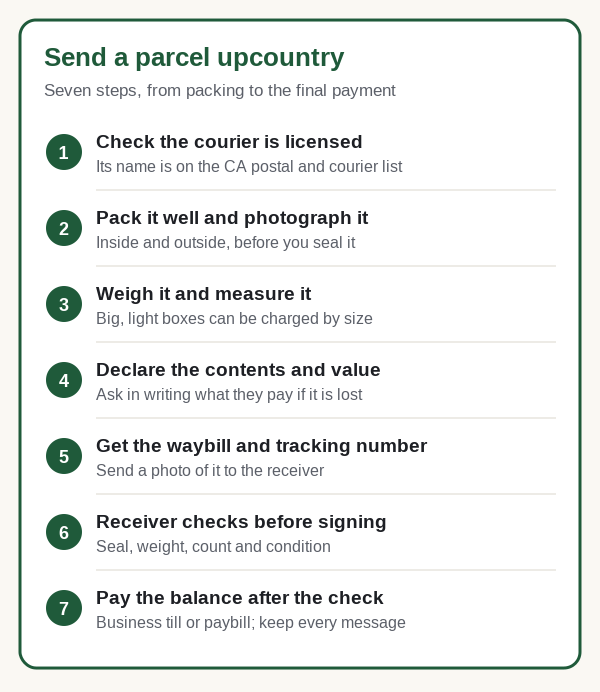
To send a parcel upcountry without drama:
- 1. Check the courier is on the CA list of licensed postal and courier operators[1]
- 2. Pack the goods well and photograph them before you seal the box
- 3. Weigh and measure the parcel, and ask how they will charge it[3]
- 4. Declare the contents and value, and ask what they pay if it is lost
- 5. Get the waybill and tracking number, and send a photo of it to the receiver
- 6. The receiver checks the parcel at the counter before signing
- 7. Pay any balance after the check, to a business till or paybill
How do you know a courier is licensed?
Look for its name on the CA list. It takes two minutes.
In Kenya, postal and courier services are licensed by the Communications Authority of Kenya (CA). CA publishes a register of licensed postal and courier operators on its website, updated from time to time[1].
The current list is dated October 2026[1]. It groups operators into international and national postal and courier operators, plus the public postal operator, Posta[1].
You may be surprised who is on it. The list includes bus companies and some transport saccos, not only the big courier brands, so a parcel office at a bus stage can be licensed[1].
You may also be surprised who is not. In August 2025, CA and the National Police Service raided unlicensed parcel services at bus stages in Mombasa, after a similar raid in Nairobi a week earlier[2].
CA said it "cautions members of the public to seek parcel and courier services from CA licensed providers only"[2].
Those charged were accused of operating postal services without a valid licence under section 49 of the Kenya Information and Communications Act, 1998[2].
Why does it matter to you? A licensed operator answers to a regulator, and CA takes consumer complaints[8]. If your parcel disappears, you have someone to complain to beyond the clerk at the counter.
So before you hand over a box, open the CA list and search for the exact company name on the receipt.
How should you pack a parcel for a long trip?
Pack it as if it will be dropped, stacked and rained on. On a long trip, it might be.
Use a strong box. A new carton is better than a used one that has gone soft at the corners.
Fill the gaps. Newspaper, old clothes or bubble wrap stop things moving. If you shake the box and hear sliding, add more.
Wrap liquids twice. Seal bottles in a plastic bag first, then pack them upright in the middle of the box.
Tape every seam. Use wide packing tape across the top, the bottom and the edges.
Label it clearly. Write the receiver's full name, phone number and destination town on the box, and your own name and number too.
Photograph everything. Take photos of the goods laid out, then the packed box open, then the sealed box. These photos are your proof later.
Before you pack things like cooking oil, food, cash, phones or anything flammable, ask the courier what it will and will not carry.
How much does it cost to send a parcel upcountry?
Prices depend on the courier, the weight, the size and how far the parcel goes. Ask for the price in writing before you pay.
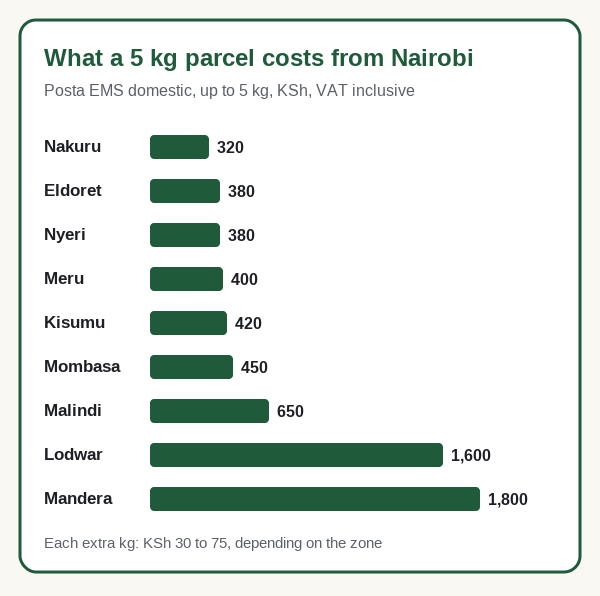
For a real example, the Postal Corporation of Kenya (Posta), the public postal operator on the CA list[1], publishes its EMS domestic rates from Nairobi, VAT inclusive[4]. We use them only as a public yardstick, checked in November 2026.
For a parcel of up to 5 kg, Posta lists KSh 320 to Nakuru, KSh 380 to Eldoret or Nyeri, KSh 400 to Meru, KSh 420 to Kisumu and KSh 450 to Mombasa[4].
Farther away costs more: KSh 650 to Malindi, KSh 1,600 to Lodwar and KSh 1,800 to Mandera for the same 5 kg[4].
Each extra kilogram, or part of one, adds between KSh 30 and KSh 75, depending on the zone[4].
Other couriers, bus parcel offices and sacco offices set their own prices. Use the Posta table as a yardstick, not a price list for everyone.
Why does a big, light box cost more than you expected?
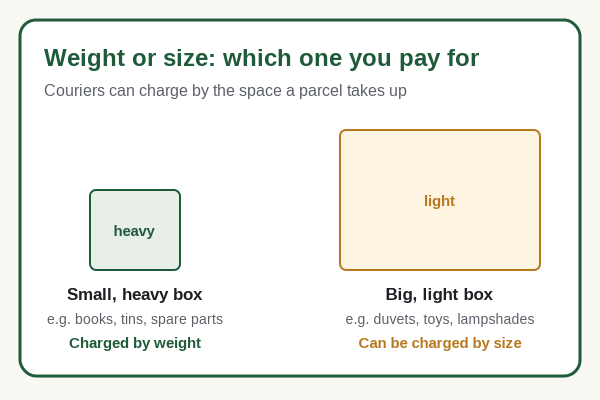
Because some couriers charge for the space a parcel takes up, not only its weight.
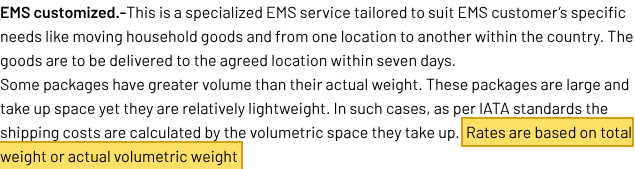
Posta explains it plainly: some packages are large but light, and in such cases, as per IATA standards, the shipping cost is calculated by the volumetric space they take up[3].
Posta says its rates are "based on total weight or actual volumetric weight"[3].
IATA is the International Air Transport Association, the global airline industry body.
So a duvet, a box of toys or a lampshade can cost more than a small box of books that weighs more.
The fix is simple. Use the smallest box that fits, and ask the clerk to tell you the charged weight before you pay.
What if the parcel is lost or damaged?
Agree this before you hand over the box, not after something goes wrong.
Ask the courier three plain questions, and get the answers in writing or on the receipt.
What do you pay if it is lost or damaged? It may be a fixed amount or the value you declared. You need to know which.
Can I declare the full value, and what does that cost? Write the value on the waybill. If there is an extra fee to cover it, decide if the goods are worth it.
What proof do you need for a claim, and how long do I have? Keep the waybill, the receipt, your photos and the declared value ready, whatever they say.
If the waybill or receipt has terms printed on it, read the part about lost or damaged goods before you sign.
For valuable business stock, also ask your own insurer whether you can cover goods while they are on the road.
If the courier will not answer these questions, that is your answer. Take the parcel somewhere else.
Their answers tell you more than the price does:
- Is your company on the CA list of licensed courier operators?[1]
- How will you charge this parcel: by weight or by size?[3]
- When will it arrive, and how will the receiver be told?
- What do you pay if it is lost or damaged, and up to how much?
- Can I declare the full value, and what does that cost?
- How long will you keep it at the branch if no one collects it?
What should the waybill say?
The waybill is the receipt and record of your parcel. Check it before you leave the counter.
It should show the courier's name, the date, the sender and receiver with phone numbers, the destination branch, the number of pieces, the weight, the contents, the declared value, the price paid and a tracking number.
If anything is wrong or blank, ask them to fix it there and then. A blank "contents" or "value" line makes a claim much harder later.
Take a clear photo of the waybill and send it to the receiver on WhatsApp. They will need the tracking number and the name on the parcel to collect it.
What should the receiver check before signing?
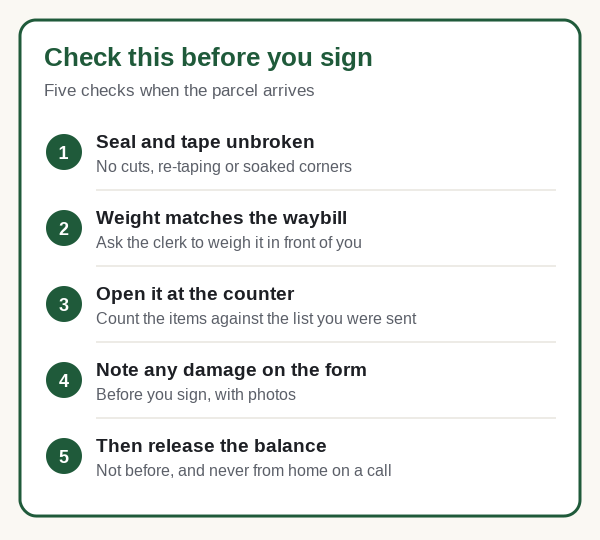
Treat your signature as saying the parcel arrived in good order. So check first, sign second.
Look at the seal and tape. Cuts, fresh tape over old tape, or wet, crushed corners are warning signs.
Ask the clerk to weigh it and compare it with the weight on the waybill. A big drop in weight needs an answer before you sign.
Open it at the counter and count the items against the list or photos the sender shared.
If anything is missing or broken, write it on the delivery form before you sign, take photos, and ask the clerk to sign or stamp the note.
How should you pay when a seller sends goods to you?
If you are buying from a seller in another town, pay the balance after you have seen the parcel, not before.
Agree this with the seller upfront: a deposit when they dispatch and send you the waybill, and the balance once you have checked the parcel at your local branch.
Pay to a business till, paybill or bank account in the seller's business name. Keep every M-Pesa message.
Be careful if a caller says your parcel has arrived but is "on hold", and asks you to send money first to get a release code.
Do not pay from home on the strength of a phone call. Go to the branch, ask to see the box with your name on it, and deal with the clerk directly.
For business purchases, ask the seller for an eTIMS invoice, issued through the Kenya Revenue Authority (KRA) electronic Tax Invoice Management System. KRA says TIMS and eTIMS invoices carry a QR code you can verify with a QR reader[5].
You can also check the invoice number on the KRA invoice checker[5][6].
How long does delivery take, and when should you send?
Delivery time depends on the courier, the route and the season. Ask for the expected delivery date in writing.
For a real example, Posta says items sent by EMS Overnight are delivered "in the shortest time within 24 hours", with a maximum weight of 50 kg[3].
Posta also says EMS Same Day works within selected towns and cities up to a 30 km radius, for items posted by 12pm[3].
Ordinary domestic Posta parcels go to the receiver's designated post office, and you can send items up to 50 kg[3].
In December, plan for delays. Many people send gifts and stock in the same few weeks, and roads are busy.
Send at least a week before the date you need the goods, and earlier for anything going far, such as Lodwar or Mandera.
What must you have before you hand over the parcel?
Have these in hand before the parcel leaves your sight.
Before you send:
- The courier's exact name, checked on the CA list of licensed operators[1]
- Photos of the goods, the packed box and the sealed box
- A waybill with the contents, weight, declared value and tracking number filled in
- The price in writing, and whether it is by weight or by size[3]
- A written answer on what the courier pays if the parcel is lost or damaged
- The receiver's full name and phone number on the box and the waybill
- A photo of the waybill sent to the receiver
Tips from how parcels really move in Kenya
A few habits save money and stress every time.
Small things that work:
- Ask the cut-off time for same-day dispatch, and hand the parcel in before it
- Ask which branch the parcel will go to. "Kisumu" can mean more than one office
- Put a copy of the receiver's name and number inside the box too, in case the outside label tears
- Split very valuable goods into two parcels, so one problem does not cost you everything
- Keep the waybill photo, M-Pesa message and chat with the courier in one place
- Ask the receiver to collect quickly, and ask whether the branch charges for parcels left too long
Don'ts: what to avoid when sending goods
Most problems come from a few habits. Avoid them every time.
Do not:
- Hand a parcel to a "tout" or anyone outside the courier office
- Use a parcel service you cannot find on the CA list[1][2]
- Leave the contents or value line on the waybill blank
- Send cash inside a parcel
- Let the receiver sign before they check the parcel
- Send money to a caller who says your parcel is "on hold"
Common mistakes, and what to do instead
Choosing on price alone. The cheapest office may not be licensed, and may not pay anything if your parcel disappears. Instead, check the CA list first, then compare prices[1].
Using a huge box for light goods. You may pay for the size, not the weight[3]. Instead, use the smallest box that fits.
No photos. Without them, it is your word against the courier's. Instead, photograph the goods, the packing and the sealed box.
Not declaring the value. Then the courier may only pay its minimum. Instead, write the real value on the waybill and ask what it costs to cover it.
Signing first, checking later. Once you sign, a claim is harder. Instead, check the seal, weight and contents at the counter, then sign.
What can you do if a courier refuses to pay for a lost parcel?
Start with the branch, then the courier's head office. Write down what happened and attach the waybill, receipt, photos and M-Pesa message.
Give them a clear date to respond, and keep every reply.
If the courier is licensed, you can also report the problem to the Communications Authority of Kenya, which licenses postal and courier operators and takes consumer complaints on its website[1][8].
If the money is the issue, the Small Claims Court may help. The Judiciary says it handles claims about contracts for the supply of goods or services, and about loss or damage to property or the delivery or recovery of movable property[7].
The Judiciary says the court can hear claims of up to one million shillings, and the law sets 60 days for it to finish a case[7].