How do you hire a security company you can trust in Kenya?
Write down what you need guarded and when, ask two or three firms for written quotes, check each firm's PSRA licence and the Guard Force Number of every guard, and sign a contract that lists posts, shifts, duties, liability and notice. Pay by invoice, never cash.
Security is one service where a cheap mistake costs twice.
A guard who sleeps on duty, a firm that sends a different person every night, or a company with no licence can leave your shop, office, home or event open. And the law can come back to you.
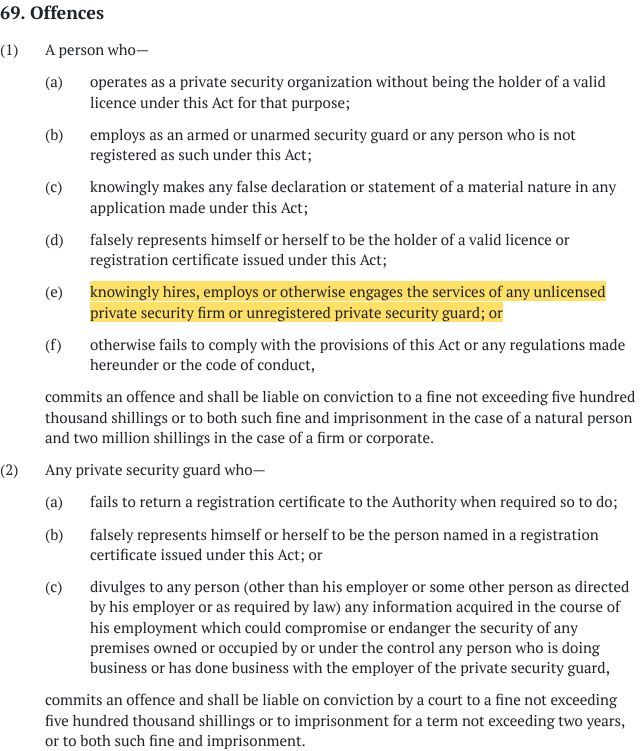
Under the Private Security Regulation Act, 2016, a person who knowingly hires an unlicensed private security firm or an unregistered guard commits an offence[1].
So the aim is simple. Hire a licensed firm, check the guards it sends, and agree everything in writing.
December is busy for this. Shops stock up, offices close for the holidays, and weddings and end-year parties need crowd control. Start your checks early so you are not choosing in a rush.
To hire a security company:
- 1. Walk your premises and list each post, the hours and the risks (stock, cash, gates, parking)
- 2. Ask two or three firms for a written quote for the same list
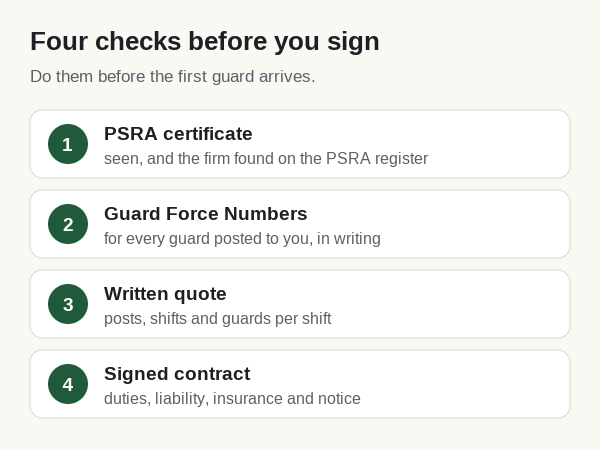
- 3. Ask each firm for its PSRA certificate and check it against the PSRA register[1][3]
- 4. Ask for the names and Guard Force Numbers of the guards it will post[3]
- 5. Ask how supervisors check guards at night and how fast they respond to an alarm
- 6. Sign a contract with posts, shifts, duties, liability, insurance and notice
- 7. Check the guards on the first night and keep a copy of every GFN
Does a security company need a licence in Kenya?
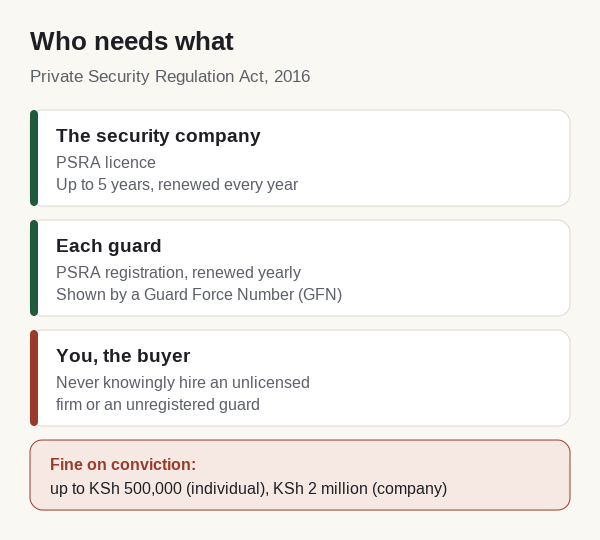
Yes. The Act says a person shall not provide or offer private security services in Kenya for a fee unless licensed by the Private Security Regulatory Authority (PSRA)[1].
Individuals are covered too. Every security guard, private security officer and individual provider must be registered by PSRA before working for a fee[1].
A firm also may not employ a guard, a security officer or a trainer who is not registered under the Act[1].
To get a licence, a firm must be a company incorporated in Kenya, or a foreign firm registered in Kenya with at least 25% local shareholding. Its managers must be registered with PSRA, and the firm must pass security vetting[1].
A licence lasts up to five years, subject to annual renewal[1]. So a certificate dated three years ago may be fine, but ask whether this year's renewal is done.
PSRA enforces this. In March 2026 the Authority told the Senate Security Committee it had closed 27 unlicensed firms in a nationwide crackdown[4].
Can you be fined for hiring an unlicensed security firm?
Yes. Section 69 of the Act makes it an offence to knowingly hire, employ or engage an unlicensed private security firm or an unregistered security guard[1].
The penalty on conviction is a fine of up to KSh 500,000, or the fine and imprisonment, for an individual, and up to KSh 2 million for a firm or company[1].
The same section covers anyone who employs a security guard who is not registered[1]. That matters if you hire a watchman directly for your home, shop or plot.
PSRA has said this out loud. In a 2024 statement its CEO said all users and potential users of private security services must make sure companies only employ officers who are trained, registered and hold Guard Force Numbers[2].
The word "knowingly" in the hiring rule matters, so doing the checks in this guide and keeping proof is your best protection. The rule on employing an unregistered guard yourself does not use that word, so check registration before a directly hired watchman starts[1].
A firm without a current licence cannot offer services for a fee[1]. Ask for the certificate now, not after the contract. If it is "being processed", wait or pick another firm.
How do you check a security company and its guards?
Ask for two things: the firm's PSRA certificate of registration as a corporate private security service provider, and the Guard Force Number (GFN) of each guard it will post at your premises[3].
The firm. PSRA must keep a register of every licensed firm and registered person, with names, registration numbers and dates of issue[1].
The Act says that register is open to inspection by any person at all reasonable times, and PSRA must keep it on an up-to-date official website[1].
In 2024 PSRA pointed a state corporation to its website, psra.go.ke, for the list of security companies that had been vetted, registered and licensed[3]. Look for the firm's exact registered name in that list.
If the website will not load, ask PSRA directly to confirm the firm. The register is open to the public by law[1].
The guards. In a February 2024 statement PSRA called the GFN the only proof that an individual guard has been registered and licensed by the Authority[3].
A guard's registration lasts up to one year. To renew it, the guard must show at least a week of security training in the past year[1].
To be registered at all, a guard must be over 18, a Kenyan citizen or ordinarily resident, hold at least a primary school certificate, have trained at a PSRA-accredited institution, and produce a certificate of good conduct from the Directorate of Criminal Investigations[1].
Ask for each guard's name and GFN in writing, and ask the firm to tell you before it swaps a guard.
What can a private security guard legally do?
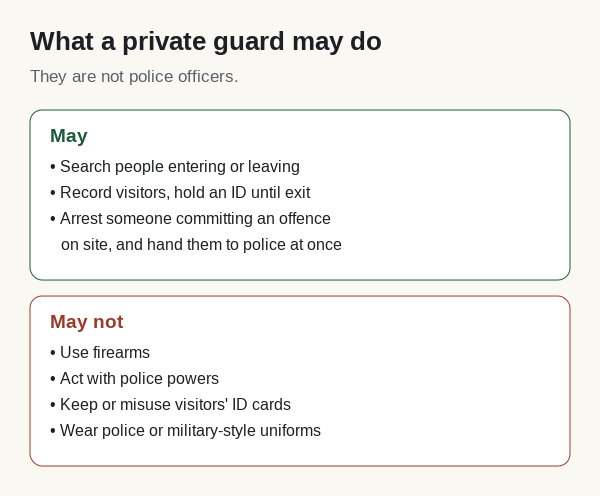
A guard can control entry, search people coming in or out of the property they guard, take down visitor details, and arrest someone who commits an offence on the premises. They are not police officers[1].
Search. A guard manning a building may search a person on entry or exit without a warrant, but must not infringe the person's rights under the Constitution[1].
Arrest. A guard may arrest a person who commits an offence on the premises they are responsible for, and must immediately hand that person to the nearest police station or post[1].
Identity cards. At the gate a guard may ask visitors to identify themselves, record their time in and out, and hold their ID card for a while. The card must be kept safe, used only for identification and handed back at exit[1].
No police powers. The Act says nothing in it gives a private guard the powers of a police officer[1].
No guns. A private security provider shall not use or allow the use of firearms in providing a security service[1].
A guard who abuses the power to search or arrest commits an offence, and the firm can lose its licence[1]. Tell the firm, in writing, how you expect visitors and staff to be treated at your gate.
Do CCTV and alarm installers need a PSRA licence too?
Yes, under the Act's definitions. "Private security services" include installing burglar alarms, CCTV, access control, car tracking, guard dog services, cash in transit and locksmiths[1].
So if you are buying a CCTV system, an electric alarm or an access control gate from installers who offer these for a fee, ask for the same PSRA check as a guarding firm.
A firm that uses guard dogs must handle them in a way that is not cruel, and animal welfare laws apply[1].
Uniforms matter as well. A private security provider must not use uniforms, vehicle colours, names or logos that look like those of the police, military or other disciplined forces[1].
If guards arrive dressed like police officers, that is a warning sign about the firm.
What should you do with visitor books and CCTV footage?
Treat them as personal data. A visitor book holds names, ID numbers and phone numbers, and CCTV records faces. The Data Protection Act, 2019 says personal data must be collected for a clear purpose, limited to what is needed, and kept no longer than necessary[5].
The PSRA Act adds its own rule: details taken from a visitor at the gate must be used only to identify that person[1].
Agree in the contract who keeps the visitor books and footage, where they are stored, and how long they are kept.
Ask the firm to hand the books back to you, or destroy them, when the contract ends.
If your business holds other personal information, the Data Protection Act, 2019 duties apply to that too[5].
A short sign saying the premises use CCTV and a visitor register, and why, helps you meet the Data Protection Act duty to process personal data fairly and in a transparent way[5].
What should a security contract say?
A security contract should name every post, the shifts and number of guards at each, what the guards must do, how relief guards cover breaks and leave, how fast the firm responds to an alarm, who pays for losses, and how either side can end the deal.
Firms use their own contract forms. Make sure yours covers the points below, and ask the firm to sign each page.
Losses are the hardest part. Some firms limit what they will pay if something is stolen on their watch. Read that clause slowly and ask whether the firm carries insurance that covers it.
Before you pay, have in writing:
- The firm's PSRA certificate number and the Guard Force Number of each guard[3]
- Each post, the shift times, and the number of guards per shift
- Relief cover: who stands in when a guard is sick, on leave or on break
- Duties: gate control, patrols, visitor register, key holding, alarm response
- Supervisor visits, especially at night, and how you can report a problem
- Response time to an alarm or a call, if response is part of the service
- Liability for losses, the cap if any, and the firm's insurance
- Who keeps visitor books and footage, and for how long[5]
- The price per month or per shift, VAT shown, and the notice period
How much does a security company cost in Kenya, and how long does it take?
Guarding prices vary from firm to firm. The price depends on how many guards you need, day or night shifts, how many hours each shift runs, extras like an alarm, a dog or a response team, and the location.
The way to compare fairly is to send each firm the same written list of posts and hours, and ask for a quote that splits the price by guard and by shift.
Check the tax line. VAT in Kenya is 16% on most taxable goods and services[6]. Ask each firm whether its price includes VAT, so you compare like with like.
Ask for an eTIMS invoice. KRA says that from 1 January 2024 a business expense must be supported by an electronic tax invoice to be claimed[7].
Be wary of a quote far below the others. Guards must be trained and registered[1], and the law tasks PSRA with setting standards that ensure compliance with minimum wage rules[1]. A price that cannot cover that is a warning.
For timing, we suggest allowing at least a week for a normal premises: a site visit, quotes, the PSRA and GFN checks, and the contract. For a December event, we suggest booking two to three weeks ahead so the firm can plan guard numbers.
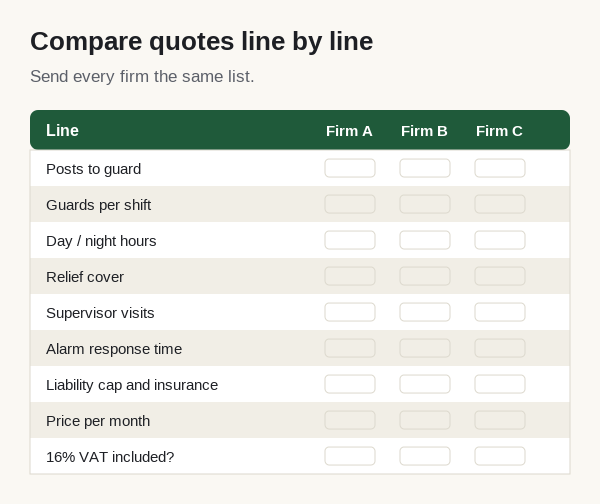
What tips help you get good security for your money?
A little routine on your side keeps the guards sharp and the firm honest.
Small habits that work:
- Walk the premises with the firm before it quotes, so the posts match the real risks
- Keep a list of the guards' names and GFNs at reception or on your phone[3]
- Drop in unannounced at night now and then, or ask a neighbour to
- Check the occurrence book every week and ask about anything odd
- Give guards a short written list of your rules: who may enter, after what time, with what pass
- Pay by bank or Paybill against an invoice, never cash to a supervisor
What should you never do when hiring security?
Most losses come from a few habits. Avoid them every time.
Do not:
- Hire a firm that cannot show a current PSRA licence[1]
- Accept guards without Guard Force Numbers[3]
- Hire a watchman directly without checking that they are registered[1]
- Accept a private firm's own guards carrying guns: section 53 bars private security providers from using firearms[1]
- Let guards keep visitors' ID cards after they leave[1]
- Sign a contract that does not say who pays for losses
What mistakes do buyers make when hiring security?
Choosing by price alone. The cheapest quote may mean one guard covering two posts, or no relief cover. Instead, compare quotes for the same written list of posts and hours.
Skipping the licence check. A logo on a uniform is not a licence. Instead, see the PSRA certificate and find the firm on the PSRA register yourself[1][3].
Not knowing who is at your gate. Guards change without notice. Instead, keep the names and GFNs of every guard, and ask to be told before a swap[3].
No written duties. Arguments start over "that was not our job". Instead, list every duty in the contract.
Ignoring the liability clause. Some firms cap what they pay after a theft. Instead, read the cap, ask about insurance, and insure your own stock too.
Forgetting the paperwork. Without an eTIMS invoice you may not be able to claim the cost as a business expense[7]. Instead, ask for one every month.