How do you hire a trustworthy accountant or tax agent in Kenya?
Decide what work you need, check the person on the ICPAK member or firm search, confirm any tax agent licence with KRA, compare two or three written quotes, and sign an engagement letter that lists the work, fee and deadlines. Keep your own iTax login and copies of everything.
This matters more than it looks.
Your accountant sees your bank statements, your M-Pesa records and your PIN. A good one saves you penalties and stress. A bad one can leave you with returns you never saw and a KRA demand in your name.
And the law is clear on whose name that is. KRA says appointing a tax agent does not relieve you of any obligation the agent fails to perform[4].
So the aim is simple: hire someone qualified, agree everything in writing, and stay able to see your own tax account.
November and December are a good time to do it. Individual returns for 2026 can be filed from 1 January 2027[7], and a new accountant needs time to collect your records first.
To hire an accountant or tax agent:
- 1. Write down the work: bookkeeping, monthly returns, annual returns, audit, or a KRA issue
- 2. Ask two or three people or firms for a written quote for the same list
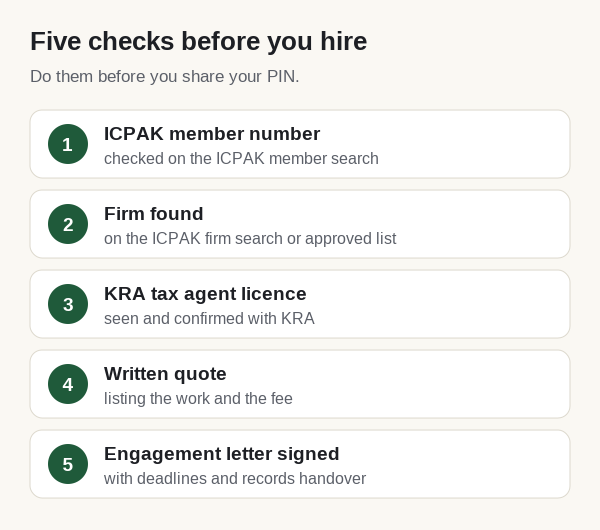
- 3. Check each one on the ICPAK member or firm search, and confirm any tax agent licence with KRA[14][6][5]
- 4. Ask who will do the work, and how they will reach you before each deadline
- 5. Sign an engagement letter with the work, fee, dates and records handover
- 6. Give written permission for PIN use, and keep your own iTax login[2]
- 7. Ask for a copy of every return and payment slip, every time
Do you need an accountant, a tax agent or a bookkeeper?
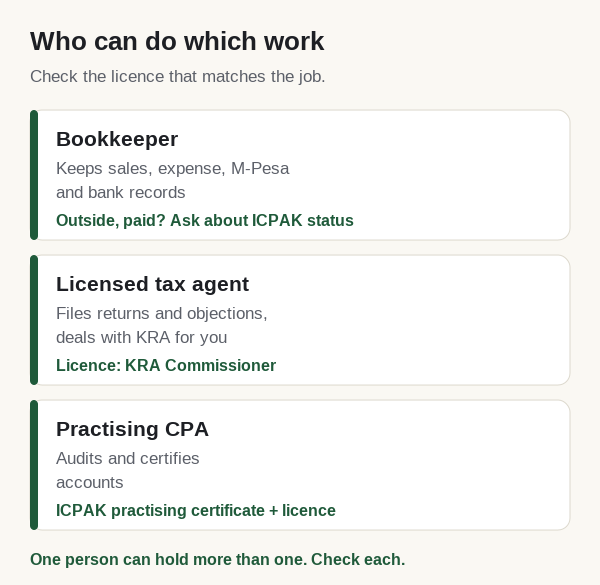
It depends on the work. A bookkeeper keeps your records. A licensed tax agent files returns and deals with KRA for you. A practising CPA is needed for an audit or for certifying accounts.
Bookkeeper. Records sales, expenses, M-Pesa and bank transactions, and keeps receipts in order. A bookkeeper on your own payroll is the simplest start. If you pay an outside person or firm for accounting work, ask whether they hold an ICPAK practising certificate, because the Accountants Act defines practising widely[1].
Tax agent. A person or partnership licensed by the KRA Commissioner to prepare tax returns and notices of objection and to deal with KRA on a taxpayer's behalf[2][5].
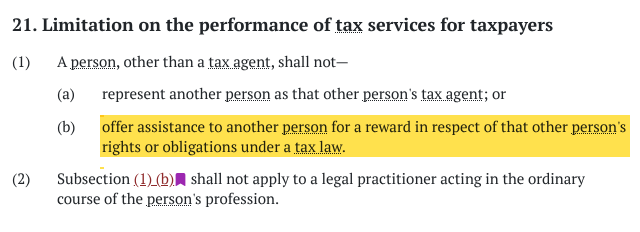
The Tax Procedures Act says a person who is not a tax agent shall not represent you as your tax agent, or offer you help with your tax rights or obligations for a reward. Advocates acting in the ordinary course of their profession are the exception[2].
Practising accountant (CPA). Under the Accountants Act, a person practises as an accountant if, for pay, they engage in the practice of accountancy or hold themselves out as entitled to, or offer auditing or verification of books and accounts, or verification or certification of financial accounts[1].
The Act defines accountancy widely, including accounting and taxation. A salaried employee doing this work for their own employer is not practising[1].
Nor is an advocate, a Certified Public Secretary or a person authorised under another written law, such as a licensed tax agent, who carries on only the work of a tax consultant or tax advisor[1].
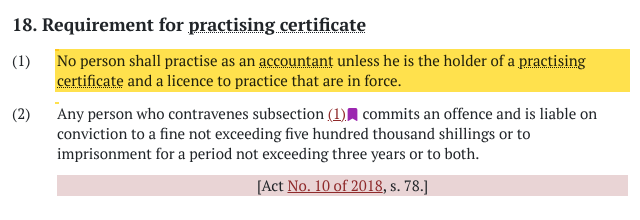
No person may practise as an accountant without a practising certificate and a licence to practise that are in force[1]. Breaking that rule can bring a fine of up to KSh 500,000, up to three years in jail, or both[1].
One person can be all three. A CPA in practice who is also a licensed tax agent can keep your books, file your returns and handle KRA. Just check each licence separately.
How do you check that an accountant is licensed?
Use the Institute of Certified Public Accountants of Kenya (ICPAK) search on its website. It has a member search by ICPAK member number and a firm search by name or PF number, with a county filter and the list of approved firms for 2026[14][6].
Ask the accountant for their ICPAK member number and their firm's name. A genuine practitioner will give both without fuss.
Look at the letters too. Under the Accountants Act a full member of ICPAK uses C.P.A. (Kenya), often written CPA (K), and a Fellow uses F.C.P.A. (Kenya), often FCPA (K)[1].
The Accountants Act makes it an offence to use those titles or letters falsely, with a fine of up to KSh 2 million[1].
Check the date as well. A firm's annual licence runs from the date it is issued to 31 December of that year and must be renewed[1]. So a licence shown to you in November may need renewing in January.
If you need audited accounts, there is one more check. ICPAK says every audit opinion signed by a practising member carries a Unique Document Identification Number (UDIN), an 11-digit code you can verify on its licences portal[11].
When you find the person or firm on the ICPAK search, take a screenshot with the date showing and save it with your engagement letter. If anything goes wrong later, you have proof of what you checked.
How do you check a tax agent?
Ask for their KRA tax agent licence, then confirm it with KRA. The law lets KRA publish a list of licensed tax agents from time to time[2][3], but we found no searchable list on its website.
So ask the KRA Contact Centre on 020 4 999 999 or 0711 099 999, or email callcentre@kra.go.ke[5].
A KRA tax agent must be licensed by the Commissioner, after a recommendation from KRA's Tax Agents Committee[2][3].
KRA's guide on the role of a tax agent lists who qualifies: an accountant registered under the Accountants Act and a member of ICPAK, an advocate with a current practising certificate, a former tax administrator with at least ten years' experience, or someone with other qualifications KRA recognises. They must also be tax compliant[5].
The licence can be taken away. The Commissioner must cancel it if a return the agent prepared and filed is false in a material way, unless the agent shows it was not due to wilful or negligent conduct[2].
It is also an offence for a tax agent to help a client set up a tax avoidance scheme or to help them evade tax[2]. If someone promises you a "special arrangement" with KRA, walk away.
Which tax deadlines should your accountant handle?
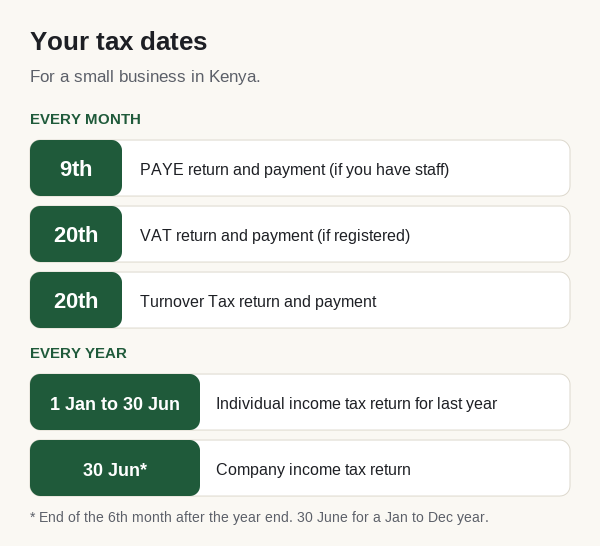
Most small businesses in Kenya face monthly returns and one annual return. Your accountant should know every one that applies to you and remind you before each.
PAYE: if you have employees, the PAYE return and payment are due by the 9th of the following month[8].
VAT: if you are VAT registered, the return and payment are due on or before the 20th of the following month[9]. Registration is required once taxable sales reach KSh 5 million a year[9].
Turnover Tax (TOT): for businesses with gross turnover above KSh 1 million and up to KSh 25 million a year, the return and payment are due by the 20th of the month after the tax period[10].
Individual income tax: returns for a year can be filed any time between 1 January and 30 June of the following year[7].
Company income tax: a company files its return on or before the end of the sixth month after its accounting period ends. For a January to December year, that is 30 June[12].
Ask your accountant to put these dates in writing for your business, with the day they need your records before each one.
What does it cost if returns are late?
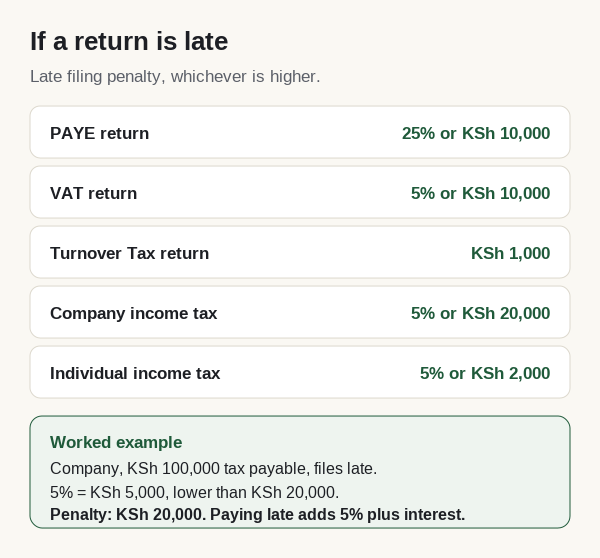
Late returns carry fixed penalties under the Tax Procedures Act. The minimum amounts apply even when the tax due is small, so a late return can cost far more than the tax itself[2].
For a late employment income (PAYE) return: 25% of the tax due or KSh 10,000, whichever is higher[2].
For a late VAT return: 5% of the tax payable or KSh 10,000, whichever is higher[2].
For a late Turnover Tax return: a flat KSh 1,000[2]. (KRA's Turnover Tax page still says KSh 1,000 per month[10], but the Act as now in force sets one penalty of KSh 1,000 per late return[2].)
For other returns, such as income tax: 5% of the tax payable or KSh 20,000, whichever is higher, for a company or other non-individual, and 5% or KSh 2,000 for an individual[2][7].
Paying late adds a separate late payment penalty of 5% of the tax due[2]. KRA also charges late payment interest of 1% a month on unpaid tax until it is paid[7].
A worked example: a small company with KSh 100,000 of income tax payable files its annual return late. 5% of KSh 100,000 is KSh 5,000, which is lower than KSh 20,000, so the late filing penalty is KSh 20,000.
The Act works out the 5% on the tax still owed under the return, after amounts already paid and withholding tax credits[2].
An individual with KSh 30,000 of tax payable who files late pays the higher of 5% (KSh 1,500) or KSh 2,000, so KSh 2,000[2][7].
Who is responsible if your accountant gets it wrong?
You are, in the eyes of KRA. KRA says the appointment of a tax agent does not relieve you of any obligation the agent fails to perform, so you should keep up to date with your own tax records[4].
That is why your own access matters.
The Tax Procedures Act allows a tax agent to use your PIN only if you have given written permission, and only for your tax affairs[2]. Give that permission in writing, with the agent's name and the work it covers.
Keep your own iTax login. After each deadline, log in and check that the return was filed and the payment shows. It takes five minutes.
Records stay your duty too. The law says you must keep tax documents for five years from the end of the period they relate to[2]. Ask your accountant to return or copy your records whenever you ask.
If you lose money because of an accountant's negligence, you may have a claim against them. Speak to an advocate. You can also raise a complaint with ICPAK, which links to "Lodge a Complaint" on its website[6].
Some people ask for your PIN and password, file without showing you anything, and keep the login. Give written permission instead[2], ask for a copy of every return before it goes in, and change your password if you stop working together.
What should the engagement letter say?
An engagement letter is the written agreement between you and your accountant. It sets out what they will do, what you will provide, what it costs and when.
There is no fixed legal form for small clients, so make sure it covers the points below. If they will not put it in writing, that is your answer.
Before you pay, have in writing:
- The exact work: which returns, how often, bookkeeping, payroll, audit, KRA letters
- Who does the work, and their ICPAK number or KRA tax agent licence[14][2]
- The fee: monthly, per return or per job, and what counts as extra work
- The date you send records each month, and the date they file
- Written permission for PIN use, limited to your tax affairs[2]
- A copy of every return and payment slip sent to you
- Your records returned to you if the work ends, kept for five years[2]
- Confidentiality of your financial and personal information
How much does an accountant cost in Kenya, and how long does it take?
There is no official fee list for small business accounting in Kenya. Fees depend on how many transactions you have, how many returns you file, whether you have staff on payroll, and the state of your records.
What you can control is how you compare. Send each accountant the same list of work and ask for a written quote that splits the fee by task.
Common fee shapes are a fixed monthly fee for bookkeeping and monthly returns, a fee per annual return, and a separate fee for one-off work like an audit or a KRA objection.
Ask what happens if your records are messy. Cleaning up a year of unrecorded M-Pesa sales takes far longer than filing a return from neat books, and it is fair for that to cost more.
Ask about eTIMS too. KRA says that from 1 January 2024, a business expense must be supported by an electronic tax invoice to be claimed[13]. An accountant who checks your suppliers' invoices can protect your deductions.
For timing, give a new accountant a few weeks before your first deadline. They need your previous returns, bank and M-Pesa statements, and your sales and expense records first.
What habits make working with an accountant easier?
A little routine on your side makes the whole job cheaper.
Small habits that save money and stress:
- Keep business and personal money in separate M-Pesa lines or accounts
- Send records on the same day every month, even when sales were slow
- Ask suppliers for eTIMS invoices at the time you pay, not at year end[13]
- Keep one folder, on paper or phone, for every return and payment slip
- Check your iTax account after every deadline
- Ask your accountant for a short note after each filing: what was filed and what you paid
What should you never do when hiring an accountant?
Most losses come from a few habits. Avoid them every time.
Do not:
- Hire someone for audit or certified accounts without checking their ICPAK practising status[1][6]
- Pay someone to deal with KRA for you who is not a licensed tax agent or an advocate[2]
- Hand over your iTax password and lose your own access
- Pay fees in cash with no receipt or written quote
- Accept a promise of a "deal" with KRA or a tax figure that sounds too good[2]
- Leave your records only with the accountant
What mistakes do business owners make with accountants?
Hiring by price alone. The cheapest quote may skip payroll or leave out the annual return. Instead, compare quotes for the same written list of work.
Not checking the licence. A title on a business card is not a licence. Instead, check the ICPAK member or firm search and confirm any tax agent licence with the KRA Contact Centre yourself[14][6][5].
Thinking the agent carries the risk. Penalties land on your PIN. Instead, check iTax after each deadline[4].
Waiting until June. The individual return window opens on 1 January[7]. Instead, hire early and file when your records are ready.
No written agreement. Arguments about what was "included" start here. Instead, sign an engagement letter before work starts.
Losing your records. You must keep tax documents for five years[2]. Instead, keep your own copies of everything.